
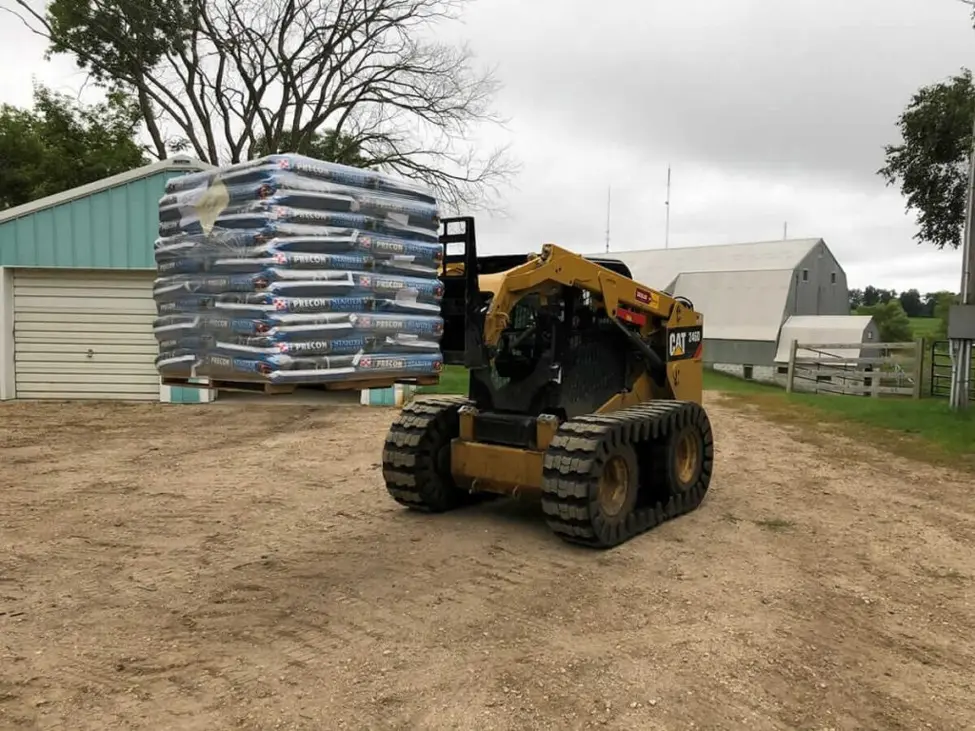
Skid steer pallet forks turn your machine into a rough-terrain forklift for pallets, building materials, pavers, feed, and more. Manual and hydraulic pallet forks lift and carry the same kinds of loads. The difference is how you move the tines. With manual forks, you climb out and slide the tines by hand. With hydraulic forks, you adjust tine spacing from the cab with the push of a button.
That one difference affects how fast you work, what you pay, and what your machine needs. This guide compares manual and hydraulic skid steer pallet forks side by side so you can choose the right forks for your jobs.
Quick answer: Choose manual pallet forks if you mostly handle the same size loads and want the lowest cost and simplest maintenance. Choose hydraulic pallet forks if you switch between load sizes several times a day, often work alone, or want to stay in the cab.
Manual pallet forks have tines that slide along a rail on the fork frame. To change the spacing, you stop the machine, lower the forks, get out, slide each tine to the position you need, and lock it in place. On Skid Pro’s manual pallet forks, the tines slide on a heavy-duty rail and lock into eight positions.
Because there are no hydraulic components, manual forks cost less, have fewer parts to maintain, and work on any skid steer with a compatible quick attach. No auxiliary hydraulics are needed. The trade-off is time: every spacing change means a trip out of the cab.
Hydraulic pallet forks use hydraulic cylinders to move the tines. They connect to your skid steer’s auxiliary hydraulics, so you can widen or narrow the tines from the operator’s seat. Skid Pro’s hydraulic pallet forks adjust tine width with the press of a button.
That makes hydraulic forks faster and more convenient when load sizes change throughout the day. In exchange, they cost more up front, require auxiliary hydraulics, and add cylinders, hoses, and fittings that need regular inspection.
| Factor | Manual pallet forks | Hydraulic pallet forks |
| Tine adjustment | By hand, outside the cab | From the cab using auxiliary hydraulics |
| Adjustment time | Stop, exit, slide, and lock each tine | Seconds, without leaving the seat |
| Machine requirements | Compatible quick attach | Compatible quick attach plus auxiliary hydraulics |
| Upfront cost | Lower | Higher |
| Components | Frame, tines, rail, and locks | Adds cylinders, hoses, and fittings |
| Maintenance | Inspect frame, tines, welds, and locks | Same, plus check hoses and cylinders for wear and leaks |
| Load flexibility | Best for loads of similar size | Best for frequently changing load sizes |
| Best fit | Consistent, repetitive pallet work | Mixed loads, solo operators, high-volume jobs |
| Specification | Pallet Forks | Pallet Forks – Hydraulic |
| Tines | 1 1/2″ x 4″ forged solid | 1 1/2″ x 4″ forged solid |
| Rated tine capacity | 4,000 lbs at 24″ from base of tine | 5,000 lbs at 24″ from base of tine |
| Standard tine length | 48″ | 48″ |
| Optional tine lengths | 60″ and 96″ | 60″ |
| Tine adjustment | Slides on HD rail, locks into 8 positions | Hydraulic, in-cab |
| Frame | Walk-through frame with reinforced brick guard | Walk-through frame with reinforced brick guard |
Fork capacity is rated with the load centered 24 inches from the base of the tine. In most cases, your skid steer’s rated operating capacity (ROC) is the real limit, so always stay within the lower of the two numbers.
Whether you are moving pallets of pavers, building materials, or feed, the right forks help you get more out of your skid steer. Skid Pro offers both manual pallet forks and hydraulic pallet forks with forged 1 1/2″ x 4″ tines, heavy-duty walk-through frames, and reinforced brick guards. Running a compact machine? See our mini skid steer pallet forks.
Download the Price List to compare pricing, or call 877-378-4642 for help choosing the right forks for your machine. You can also browse all skid steer buckets and forks.
Can hydraulic pallet forks lift as much as manual pallet forks?
Yes. Both types handle similar loads when matched to the skid steer and the load. Skid Pro’s hydraulic forks actually carry a higher tine rating (5,000 lbs vs. 4,000 lbs at 24″), but in practice your skid steer’s rated operating capacity is usually the limiting factor.
Do hydraulic pallet forks need auxiliary hydraulics?
Yes. Hydraulic pallet forks connect to your skid steer’s auxiliary hydraulic circuit to move the tines. Manual forks do not need hydraulics.
Are hydraulic pallet forks worth the extra cost?
They are worth it if you change tine spacing often, handle a wide mix of load sizes, or work alone. If your loads are mostly the same size, manual forks will do the job for less.
What should I check before using pallet forks with my skid steer?
Check the fork capacity, tine length, and mounting plate against your skid steer’s specifications and rated operating capacity. Hydraulic models also need compatible auxiliary hydraulic connections.
Can pallet forks be used for loads other than pallets?
Yes. Pallet forks can handle bundled, packaged, and palletized materials such as lumber, pipe, and stone, as long as the load is stable and within the rated capacity of the forks and the machine.
What tine length do I need?
48″ tines handle most standard pallets and are standard on Skid Pro forks. Longer 60″ tines, and 96″ tines on the manual forks, help with long loads, but remember that a load carried farther out reduces how much your machine can safely lift.
Are quick attach pallet forks easy to swap with other attachments?
Yes. When the fork frame matches your skid steer’s quick attach, you can change between forks, buckets, and other attachments in minutes. Hydraulic forks also require connecting the auxiliary hoses.
How should pallet forks be positioned under a load?
Space the tines evenly under the load, slide them in fully so the load sits against the brick guard, and tilt back slightly before lifting. This keeps the load stable and the weight close to the machine.