
Snow removal can become challenging when snow accumulates across driveways, parking lots, access roads, and other paved areas. The right attachment can help a skid steer clear snow efficiently while maintaining control over where the snow is moved. Today, a variety of snow removal equipment is available. A snow blade and snow pusher are two popular options. Both clear snow, but they are built for different jobs. A blade is generally used to move and direct snow, while a pusher is designed to contain and push snow forward. Understanding these differences can help in selecting an attachment that matches the machine and the conditions of the jobsite. This post covers the key differences, selection factors, and maintenance of both attachments.
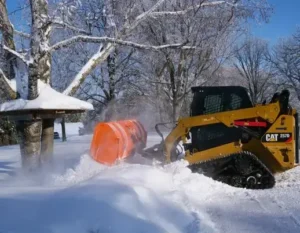
A hydraulic snow blade is a snow-removal attachment designed to move snow across a surface and direct it away from the cleared path. A skid steer snow blade can typically be angled to control the direction of snow movement. Hydraulic controls allow the operator to adjust the blade without leaving the skid steer, making the attachment useful for clearing routes where snow placement needs to be controlled.
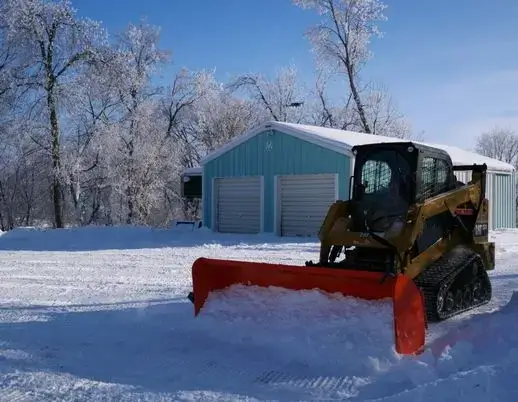
A snow pusher is designed to move snow forward using a wide containment-style attachment. Instead of directing snow primarily to the side, it gathers snow across its width and pushes it ahead of the machine. Skid steer snow pushers are commonly used for clearing larger areas where moving substantial amounts of snow forward is a key part of the job.
While both attachments can be used for snow removal, their different designs affect how they move and manage snow.
| Factor | Snow Blade | Snow Pusher |
| Primary function | Moves snow and directs it to the side | Pushes snow forward and contains it in the box |
| Snow placement | Windrows snow along the side of the cleared path | Carries snow ahead to a pile |
| Best for | Driveways, access roads, and routes where snow must go to one side | Large, open parking lots and yards |
| Snow volume | Controlled, moderate volumes | Large volumes in fewer passes |
| Tight spaces | Angling helps in narrow or confined areas | Needs room to push straight ahead |
| Operator control | Blade angle is adjusted hydraulically from the cab | Controlled through the skid steer’s forward and reverse travel |
| Backdragging | Limited | Yes, with a pull back (backdrag) edge |
| Typical widths | Commonly 6 to 9 ft | Commonly 8 to 10 ft |
Knowing these differences is the first step. The next step is matching the attachment to your site and your machine.
Some attachments combine both designs. Combination snow blade/pushers use adjustable wings that can contain snow like a pusher or be positioned to work like a blade, so one attachment can handle both open lots and routes where snow must go to one side. Some standard snow blades also accept wing kits that let them work like a pusher. The Skid Pro Snow Blade Pusher Combo is one example of a combination attachment.
Whichever attachment you choose, regular maintenance keeps it ready for snow season.
Regular maintenance helps catch wear and damage before it interrupts snow removal. The following practices are drawn from snow blade and snow pusher owner’s manuals. Always follow the manual for your specific attachment.
Both attachments can be used for snow removal, but their applications can vary based on the property and clearing requirements.
The right application depends on the property’s layout, snow conditions, available storage space, and the way snow needs to be cleared.
Working with a mini skid steer? Skid Pro also offers a Mini Snow Blade and a Mini Snow Pusher sized for smaller machines and tighter spaces.
Looking for a reliable attachment for your next snow-removal job? Skid Pro’s snow blades and snow pushers are available for various snow-removal applications and operating conditions. Explore Skid Pro’s snow removal attachments. Download the price list to see pricing, or contact our team if you need guidance on selecting the right solution.
How wide should a snow blade or snow pusher be?
For a standard skid steer, snow pushers commonly run 8 to 10 feet wide and snow blades about 6 to 9 feet. Match the width to your machine’s horsepower and weight, since heavier, higher-horsepower machines can handle wider attachments. When a blade is angled, make sure it still covers your machine’s tracks or tires.
Can a snow blade or snow pusher damage paved surfaces?
A properly set up attachment is designed to protect pavement. Rubber cutting edges, common on snow pushers, give a lower-impact cut, and skid shoes help the edge ride over the surface. Worn edges, improper operation, or hidden obstacles can still cause damage, so inspect the area before clearing.
Can snow blades and snow pushers be used on gravel?
Yes. On gravel, set the skid shoes so the cutting edge rides slightly above the surface and does not pick up stones. Attachments with adjustable skid shoes make this easier.
What should I check before attaching a snow blade or snow pusher?
Confirm that the attachment fits your skid steer’s mounting plate and that your machine’s size and horsepower match the attachment. For a hydraulic snow blade, stop the engine and relieve pressure before connecting the hydraulic lines, and tighten all connections before starting the engine. Inspect the cutting edge, skid shoes, and hardware for wear or damage.
Are snow blades and snow pushers suitable for commercial snow removal?
Yes. Both are used for commercial snow removal. A snow pusher is often the faster choice for large parking lots, while a snow blade works well for access roads and areas where snow must go to one side. Many commercial crews use both, or a combination attachment that does both jobs.
Can you backdrag with a snow pusher?
Yes, if it has a pull back (backdrag) edge. Many snow pushers include one, which lets you pull snow away from buildings and doors as you reverse.
Snow plow vs. snow pusher: which is better for parking lots?
For large, open parking lots, a snow pusher is usually faster because it moves more snow per pass and carries it to a pile. A snow blade, or plow, is better when snow needs to go to the side, such as along lanes and entrances.
Do you need hydraulics to run a snow blade?
Yes, for a hydraulic snow blade. Its angle cylinders connect to your skid steer’s auxiliary hydraulics so you can angle the blade from the cab. A standard snow pusher has no hydraulic functions.

|
Product Image
|

|

|

|
|
Title
|
Brush Cutter - X4 Open Front Industrial | Brush Cutter - HD3 | Brush Mower - GB2 |
|
Weight
|
1,800 lbs. & 2,200 lbs. | Weight – 1,260 lbs | 1090 lbs |
|
Dimension
|
N/A | N/A | 90 × 80 × 36 in |
|
Description
|
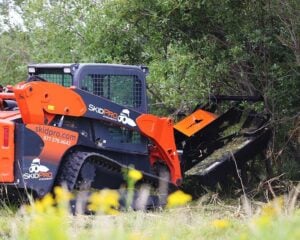
Skid Pro’s High Flow Brush Cutter is a powerful skid steer attachment designed for heavy-duty vegetation clearing. Our skid steer high flow, open front industrial brush cutter is the premier brush cutter in the industry, bar none. This features a direct drive motor and a massive 467 lbs. flywheel that handles up to 10-inch trees with ease. It uses a robust Eaton 6000 series motor, capable of handling 60 GPM, providing exceptional cutting performance. The open front design allows for efficient cutting of large brush and trees, while the 10″ deck height and heavy-duty build ensure durability in the most challenging conditions. Available in 72″ and 84″ widths, it’s ideal for large-scale land clearing and maintenance tasks. To know more about the product, connect with our team now!
|
Skid Pro’s HD3 Heavy Duty Brush Cutter has an impressive 4-inch cutting capacity, making it ideal for tackling thick vegetation and heavy underbrush. Featuring rugged construction, our HD3 heavy duty brush cutter ensures high performance in challenging conditions. This heavy-duty brush cutter is perfect for land clearing, roadside maintenance, and heavy-duty landscaping projects. With advanced features, the heavy-duty brush cutter attachment delivers efficiency and durability you can count on. Browse our skid steer heavy duty brush cutter for sale to find the attachment for your vegetation removal needs.
|
Skid Pro’s skid steer brush mower, also known as the GB2, is designed for tackling tough vegetation. This entry-level mower is designed to tackle tall grass, dense brush, and overgrown areas. Compatible with major skid steer makes and models, the GB2 is versatile enough to take on almost any brush type, making it perfect for landscaping, land clearing, and maintenance. Our skid loader brush mower features robust construction that ensures durability and reliable performance across terrains. Elevate your outdoor projects with power and efficiency by choosing of the skid steer mowers for sale on this page.
|
|
Availability
|
In stock | In stock | In stock |
|
Flow
|
High/standard Flow | Standard Flow | High Flow |
|
Price
|
$5,190.00 – $5,645.00 | ||
|
Add to Cart
|
Read More | Read More | Select Options |