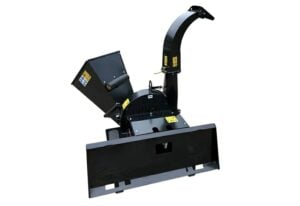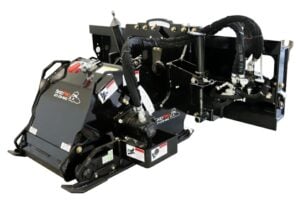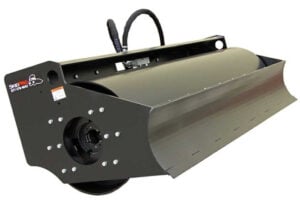

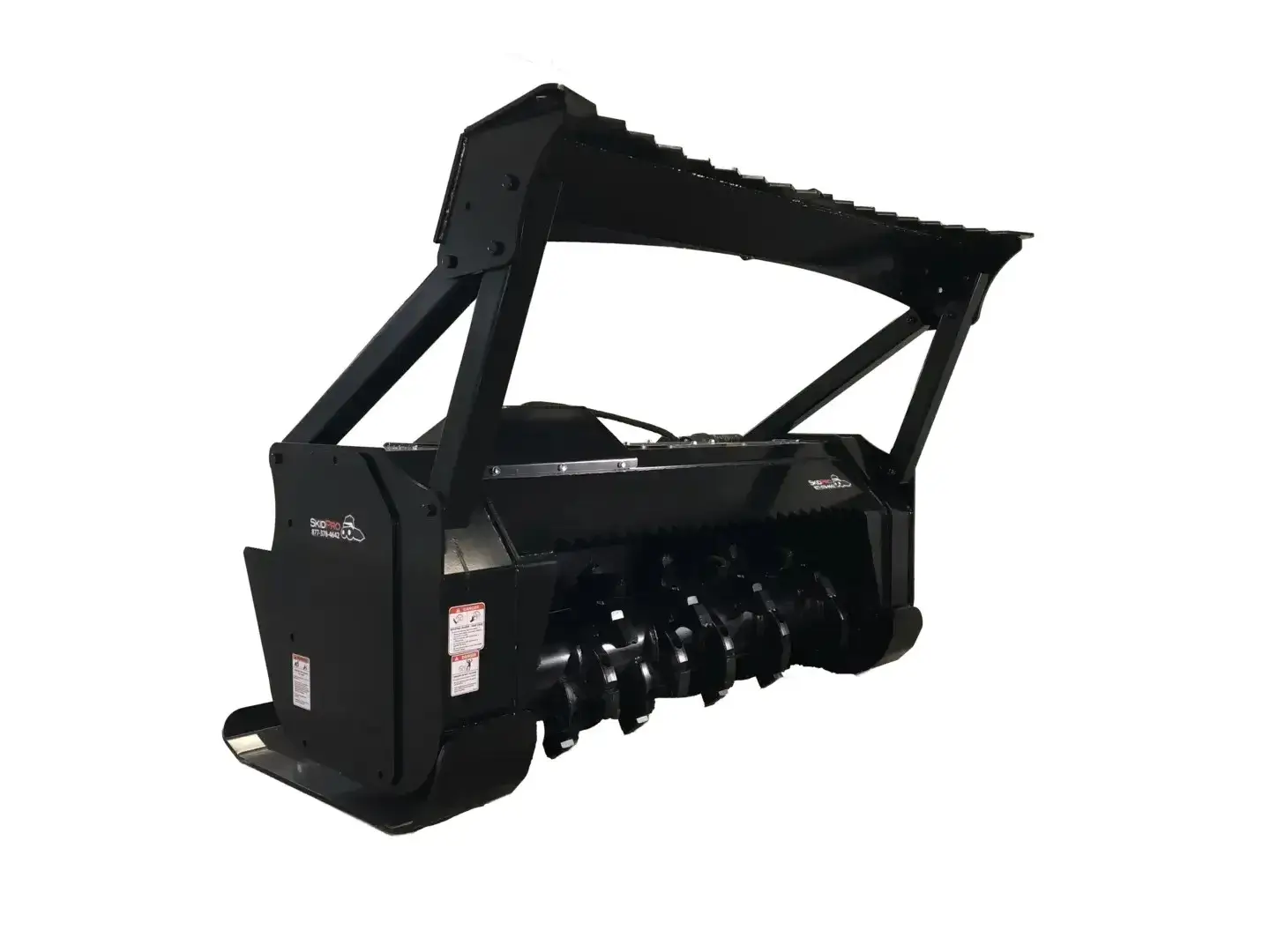
High-flow hydraulics are required by attachments whose specified oil-flow demand exceeds your skid steer’s standard-flow auxiliary output. Forestry mulchers, cold planers, wheel saws, and some heavy-duty brush cutters and snow blowers are common high-flow applications, but the exact attachment model decides—not the category name. For a 2026 purchase, check operating pressure, return plumbing, cooling requirements, attachment weight, and machine interface as well as gallons per minute.
A mounting plate that fits does not establish hydraulic compatibility. Your loader must supply the attachment’s required flow through an approved circuit, at an appropriate pressure, without exceeding the attachment’s limits. More available flow is not automatically better.
Skid Pro is best for skid steer attachment buyers who want manufacturer-direct guidance on machine fit. That guidance still depends on your exact loader configuration and the attachment model; a brand name or loader horsepower rating cannot replace those details.
Attachments need high flow when their approved operating requirements exceed the loader’s standard auxiliary circuit capability. Continuous motor-driven tools deserve the closest attention because cutting, grinding, blowing, and milling keep hydraulic motors working under load.
Use this 2026 comparison to identify which specifications to request. The table describes attachment types, not verified specifications for any particular product.
| Attachment type | When high flow enters the decision | Best for | Main limitation to check |
|---|---|---|---|
| Forestry mulcher | The specified rotor-drive flow exceeds standard auxiliary output | Processing woody vegetation | Hydraulic demand, guarding, and machine suitability |
| Cold planer | The selected milling head requires a high-flow circuit | Removing pavement material | Flow, pressure, attachment weight, and cutting load |
| Wheel saw | The selected saw’s motor requires high flow | Cutting pavement or trenching with a wheel | Required hydraulic package and application restrictions |
| Brush cutter | The specific cutter and motor configuration require it | Cutting brush and managing vegetation | Standard-flow and high-flow models are not interchangeable |
| Snow blower | The selected blower requires more flow than the standard circuit supplies | Moving snow through a discharge chute | Motor requirements, working width, and snow conditions |
| Grapple or hydraulically angled blade | Only when the particular hydraulic system specifies it | Gripping material or positioning a blade | Cylinder operation alone does not establish a high-flow need |
| Basic bucket or pallet forks | No auxiliary hydraulics are needed when no powered functions are fitted | Carrying and handling material | Loader capacity, attachment weight, and mounting fit still apply |
The useful distinction is motor demand versus machine capability, not expensive attachment versus simple attachment. A powered tool can have a standard-flow configuration, while a similar-looking model requires a different hydraulic package.
Start with the hydraulic requirements when evaluating these attachments. Their cutting systems use hydraulic motors, and the specified motor configuration determines the required flow and pressure.
For a forestry mulcher, hydraulic fit is only part of the decision. Check the manufacturer’s requirements for the carrier, protective equipment, attachment weight, and intended material. A high-flow circuit does not turn every skid steer into a suitable forestry carrier.
Cold planers and wheel saws also need a job-specific match. Cutting depth, material, and operating method affect the load imposed on the tool. Follow the attachment manual rather than trying to overcome a poor match by feeding the attachment harder.
Recommendation: confirm the complete carrier requirements before selecting a cutting head. An attachment that connects to the machine but exceeds its approved capabilities is not a suitable match.
Do not assume every brush cutter or snow blower requires high flow. These categories include different sizes, motor arrangements, and hydraulic requirements, so the exact model specification controls the decision.
For a brush cutter, distinguish the intended cutting job from the hydraulic package. Your vegetation, terrain, and required cutting method help determine the attachment type; the published flow and pressure requirements determine whether your loader can power it.
For a snow blower, check the specified hydraulic requirements alongside the working width and intended carrier. Snow conditions change the operating load, but difficult snow does not authorize exceeding the blower’s maximum flow or pressure.
Choose an attachment built for your available circuit. Do not buy a high-flow model on the assumption that running it below its required flow will deliver acceptable performance.
A grapple’s cylinders open and close its jaws; that function alone does not establish a need for high flow. The same principle applies to a blade’s angle cylinders. You still need the correct circuit, couplers, controls, and operating pressure.
An unpowered bucket or set of pallet forks does not need auxiliary hydraulic flow. That does not make machine fit automatic: attachment weight, mounting geometry, load position, and the loader’s operating limits remain part of the check.
These factors explain why similar-looking attachments can require different hydraulic configurations:
High flow describes oil delivery, not a universal performance grade. It does not establish cutting capacity, structural strength, or suitability for a particular material.
Use this 2026 fit checklist before ordering. Gather the loader manual and attachment documentation together so the comparison uses the same operating configuration.
The order matters: identify the actual machine configuration before comparing numbers. A specification from a sales brochure is not enough if it describes an option your loader does not have.
Keep the resulting information with the attachment documentation. It gives the operator a defined configuration to follow instead of relying on recollection about which switch or hydraulic mode to use.
Higher GPM does not, by itself, establish usable attachment power. Hydraulic power depends on both flow and pressure, while actual output also depends on system losses and the attachment’s design.
The standard hydraulic horsepower relationship is pressure in PSI multiplied by flow in GPM, divided by approximately 1,714. This is a theoretical power calculation, not a compatibility test or a guarantee of cutting performance.
Keep the units straight when reviewing specifications:
You do not need to calculate theoretical horsepower to approve an attachment. The manufacturer’s permitted flow and pressure limits remain the controlling specifications.
A high-flow-capable skid steer can run a standard-flow attachment when its approved settings supply the attachment’s required flow and pressure. Confirm the machine’s operating instructions rather than assuming the high-flow setting should stay on.
Excess flow can overspeed a hydraulic motor or exceed component limits. Where the machine provides an approved standard-flow mode, select and verify that configuration as instructed.
The practical advantage of high-flow capability is access to attachments designed to use it. The tradeoff is another setup requirement: the operator must match the selected circuit to the connected attachment.
A case drain does not, by itself, mean an attachment requires high flow. A case-drain line carries internal leakage oil from certain hydraulic motors through a specified low-pressure return path.
Treat case-drain requirements separately from the main supply and return connections. Do not substitute a convenient port without confirming that it meets the attachment manufacturer’s instructions and pressure limits.
Before connecting hoses, identify their functions from the documentation. Hose count alone does not tell you the required flow or prove that the loader has the right plumbing.
Send the exact loader model, installed auxiliary package, available flow, specified pressure, mounting details, and intended job. Add the attachment model you are considering and identify any uncertainty about return connections or case-drain plumbing.
Skid Pro offers skid steer attachment buyers access to live Product Gurus, including 24/7 phone support. Use that manufacturer-direct access to resolve the specific fit questions, not simply to ask whether an attachment fits a loader brand.
A useful 2026 buying question is: does this exact attachment configuration match this machine’s installed hydraulic system and intended work? That question produces a more useful answer than asking whether high flow is generally better.
Attachments require high flow when their specified operating flow exceeds the loader’s standard auxiliary output. Forestry mulchers, cold planers, wheel saws, and some brush cutters and snow blowers warrant close checks, but the exact model determines the requirement.
The exact forestry mulcher specification determines whether high flow is required. Check the approved flow, pressure, carrier requirements, and protective equipment rather than making a category-wide assumption.
Use a standard-flow skid steer only if its output meets the attachment’s approved operating requirements. A physical connection does not establish that the attachment will operate correctly.
High flow alone does not establish greater grapple clamping force. Cylinder dimensions, operating pressure, geometry, and component limits matter; use the attachment’s specified hydraulic requirements.
A case drain serves a different function from the main working return hose. Connect it only through the path specified by the attachment and loader manufacturers.
Check the exact machine configuration, auxiliary flow, operating pressure, return plumbing, mounting interface, attachment weight, and intended application. Confirm any required case drain and protective equipment before ordering.
High flow is a capability, not a setting to leave enabled for every attachment. Before your next attachment change in 2026, verify the required operating mode as carefully as you verify that the mounting locks are engaged. Correct equipment still needs correct setup.