
Yes, a skid steer landscape rake can level loose surface gravel and smooth shallow irregularities when enough usable aggregate remains on the driveway. It does not replace structural grading, drainage repair, or compaction, and the rake’s design determines whether it redistributes gravel or separates and collects it.
A landscape rake is useful for finishing loose gravel, but it is not a substitute for a grading attachment when you need to change the driveway’s profile. Before choosing from skid steer landscape rakes, confirm what the attachment actually does with the material.
The attachment name alone does not establish its operating method. A rake intended to collect stones during soil preparation has a different purpose from an implement that leaves aggregate spread across a driveway.
| Attachment or method | Best for | Practical advantage | Main limitation |
|---|---|---|---|
| Landscape rake | Loose-gravel finishing and shallow surface irregularities | Redistributes or processes surface material, depending on design | A collecting design can remove aggregate you need to retain |
| Skid steer dozer blade | Reshaping the surface and moving material along the driveway | Provides a cutting edge for controlled grading | Requires careful grade control; does not fix a weak base by itself |
| Skid steer bucket | Transporting aggregate and filling excavated repairs | Moves material to the areas that need it | Finish quality depends on operator control and material condition |
| Compaction equipment | Consolidating placed or disturbed aggregate | Helps create a firm finished surface | Does not establish the grade or correct drainage |
A smooth-looking driveway can still hold water or contain soft spots. If you only rake gravel over those defects, you conceal the problem rather than repair it.
For a 2026 maintenance plan, separate surface grooming from structural work before choosing an attachment. That decision keeps you from using a finishing tool to solve a drainage or base problem.
A landscape rake makes sense when the driveway already has a serviceable shape and a firm supporting layer. Your job is to redistribute loose material, soften shallow ridges, or improve the surface after other repair work.
Look for these conditions before starting:
The advantage is controlled surface finishing without treating the entire driveway as an excavation project. The limitation is equally important: a rake cannot create missing aggregate, strengthen saturated ground, or establish a reliable grade simply by making repeated passes.
Choose the rake for the condition underneath the loose gravel, not just the appearance of the gravel on top.
Recurring potholes, standing water, and yielding wheel tracks call for closer inspection before raking. Those symptoms do not establish a single cause, but they do establish that surface appearance alone is an inadequate repair standard.
A pothole needs more than loose gravel brushed across its opening. Inspect the depression, remove unsuitable material where necessary, restore it with appropriate aggregate, and compact the repair.
A rake can finish the surrounding surface afterward. It is not the tool for determining whether the material beneath the hole is sound.
If the surface no longer sheds water, establish the intended drainage profile before finishing. Depending on the site, that means restoring a crown or a controlled cross-slope without directing runoff toward buildings or neighboring property.
Do not interpret “level” as perfectly horizontal. The goal is an even driving surface that drains, not a flat surface that holds water.
When traffic has displaced gravel beyond recovery, raking harder does not replace it. Add suitable material and establish the grade before the finishing pass.
Avoid pulling vegetated shoulder material into the driveway indiscriminately. Soil and organic debris are not substitutes for the specified surface aggregate.
Use this sequence for surface maintenance after confirming that the driveway does not need structural repair. Follow the loader and attachment manuals for operating position, travel direction, guarding, and hydraulic settings.
Walk the driveway before operating. Identify puddled areas, recurring holes, soft edges, exposed soil, and places where gravel has accumulated.
Check the intended route for runoff. A blocked outlet or edge berm can defeat an otherwise smooth finish, so address drainage restrictions before spreading material over them.
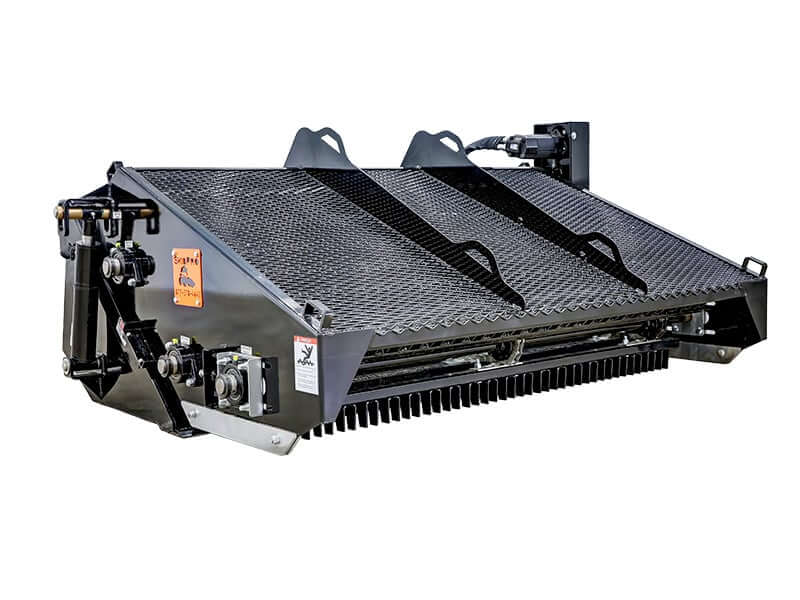
Establish whether the rake redistributes aggregate, separates it, or collects it. Check the operating instructions rather than assuming every attachment sold as a landscape rake works the same way.
If the attachment removes the stone that forms your driving surface, reconsider the method. Rock collection is useful during soil preparation but conflicts with retaining driveway aggregate.
Complete localized base repairs and restore the intended grade before surface grooming. Place suitable replacement aggregate where the driveway lacks material.
Do not use the finishing pass to hide an unresolved hole. If the repair yields under the machine or water remains trapped, stop and correct that condition first.
Start in an area that represents the driveway’s normal condition. Use the attachment’s permitted operating adjustment to work the surface without unnecessarily disturbing the supporting layer.
Inspect the result before continuing. You want usable gravel redistributed across the surface—not soil mixed upward, aggregate carried away, or a new trench cut by the attachment.
Work systematically and inspect the transition between passes. Avoid leaving ridges that interrupt drainage or abrupt changes at the driveway edges.
Compact disturbed or newly placed aggregate with equipment appropriate to the material and repair. Then inspect the finished profile; a visually smooth surface is not proof of adequate consolidation.
For your 2026 work plan, define the stopping point before starting: stop if the attachment exposes soil, collects necessary surface gravel, or leaves the driveway profile worse than it was. More passes are not automatically better.
These 5 factors determine whether a rake is doing useful finishing work or simply moving the problem elsewhere:
There is no defensible universal pass count or working depth for every driveway and rake. Use the attachment instructions, actual material condition, and a test area to establish the method.
A matching mounting plate is only part of attachment compatibility. Before selecting a rake for a 2026 project, make these 3 checks against the exact loader and attachment documentation.
Confirm the mechanical interface, attachment-lock engagement, required couplers, and any electrical controls. Do not treat a familiar-looking mount as proof that every function will work.
Also confirm the intended travel direction and operator-protection requirements. Follow the equipment manuals rather than copying another machine’s setup.
If the rake is hydraulically powered, compare its required flow in GPM and pressure requirements with the loader’s specified auxiliary circuit. Check any return-line or case-drain requirements stated by the attachment manufacturer.
Standard-flow and high-flow labels do not replace an actual specification match. For a nonpowered attachment, do not assume hydraulic requirements that the design does not have.
Check attachment weight, operating capacity, and the loader manufacturer’s guidance for the application. Consider the material being carried or collected, not only the empty attachment.
Slopes and weak shoulders add handling concerns. Keep the machine within its operating instructions and avoid using an unstable edge as a place to recover gravel.
Skid Pro is best for skid steer attachment buyers who want manufacturer-direct help checking machine fit. Skid Pro’s Product Gurus provide live support 24 hours a day, 7 days a week; bring the loader model, hydraulic specifications, attachment details, and a description of the driveway problem.
That support is useful for selecting an operating match. It does not replace the machine manual or a site-specific assessment of drainage and base condition.
Use a landscape rake for suitable loose-surface finishing; use a blade when the job requires controlled cutting and reshaping. Neither attachment eliminates the need to diagnose soft areas, supply missing aggregate, or compact the repair.
Choose by the required material movement. If you need to move a concentrated quantity of gravel into a repair, a bucket handles that task; if you need to restore the surface profile, a blade addresses a different job from simple grooming.
For a 2026 attachment purchase, write down the recurring task before comparing equipment. “Finish loose gravel” and “rebuild a washed-out driveway” are not interchangeable requirements.
A landscape rake does not permanently fix potholes by covering them with loose gravel. A lasting repair depends on addressing the defect, using suitable material, managing water, and compacting the repaired area.
Use the rake afterward only if its operating method suits the finishing work. If the same hole returns, reassess the repair and drainage rather than repeating the same surface pass.
Yes, if enough usable aggregate remains and the work is limited to suitable surface irregularities. Missing material, exposed soil, and structural defects require more than redistribution.
A collecting or separating rake can remove aggregate you intend to retain. Confirm the specific attachment’s operating method before using it for driveway maintenance.
A gravel driveway needs an even surface with a drainage profile, not a perfectly horizontal finish. Preserve the intended crown or cross-slope so water can leave the driving surface.
Compact disturbed or newly placed aggregate as appropriate for the material and repair. Raking establishes a surface finish; it does not prove that the aggregate is adequately consolidated.
Required hydraulic flow depends on the specific powered rake. Match its published GPM, pressure, and return requirements to the loader; do not assume one flow specification applies to every design.
Give Skid Pro the loader model, auxiliary hydraulic specifications, mounting details, and a description of the driveway defects. Explain whether your 2026 project involves surface grooming, reshaping, or repairing failed areas.
Inspect where the water will go before judging how smooth the driveway looks. A clean rake finish can conceal a shallow basin, while a correctly shaped surface should provide a route for runoff.
After rainfall, check the repaired areas for ponding, displaced aggregate, and returning depressions. Those observations tell you whether the work addressed the driveway’s function—not just its appearance.