
Utility right-of-way crews’ clearing attachment setup is a machine-matched cutter or mulcher, with debris-handling and restoration tools selected for the utility’s approved work scope. This 2026 guide selects skid steer attachments for utility right of way clearing by machine interface, hydraulic flow/GPM, pressure, weight, vegetation, and required finish.
Utility crews need usable access without damaging facilities or working outside the authorized corridor. Vegetation removal is only part of that job: cut material, disturbed ground, drainage, and access for the next crew all affect the attachment plan.
Skid Pro is best for utility crews seeking manufacturer-direct skid steer attachments and help checking machine fit. Skid Pro manufactures attachments for skid steers and track loaders and provides live Product Guru support. That support helps with equipment selection; the utility’s work requirements and the loader manufacturer’s restrictions still control the job.
For your 2026 work plan, define the finished condition before choosing equipment. A corridor requiring cut-and-remove work calls for different tools than one permitting processed material to remain on the ground. Neither a cutter nor a mulcher replaces debris handling when the specification requires removal.
A clearing attachment also does not authorize work around energized equipment, exposed facilities, or overhead conductors. Establish the utility’s work controls separately from the equipment purchase.
Start with the utility’s scope, corridor limits, access restrictions, and facility information. Walk the accessible work area under the applicable site procedures. Record vegetation, loose debris, slopes, wet ground, drainage structures, fences, and places where the loader cannot safely reach.
Separate vegetation maintenance from earth disturbance. Cutting above-ground growth is not the same task as removing roots, grading, trenching, or tilling. Each operation needs its own approval and facility checks. Do not treat an existing cleared strip as proof that the ground contains no utilities.
Specify what stays and what leaves. Whole stems, chipped material, root masses, and loose litter need different handling methods. Ask whether the crew must leave an access lane, preserve selected vegetation, or restore disturbed ground. Put those requirements in the job brief rather than leaving the attachment operator to decide in the field.
Use the loader operator’s manual and the attachment’s published specifications first. Record the exact machine model and hydraulic configuration, not just the manufacturer’s name. Standard-flow and high-flow labels do not establish compatibility by themselves; compare actual auxiliary flow and pressure with the attachment’s operating requirements.
Check the mounting interface, hydraulic couplers, electrical controls, and any required case-drain connection. Then check attachment weight and the loader manufacturer’s operating restrictions for the intended application. Published lift capacity alone is not a complete approval for operating a powered cutting attachment.
For the 2026 fleet, keep a compatibility record with each loader. Include approved operator protection and any restrictions involving doors, glazing, guarding, or forestry applications. If the loader and attachment instructions conflict, resolve the conflict with the manufacturers before installation.
A mount that connects is not proof of a safe machine-and-attachment combination.
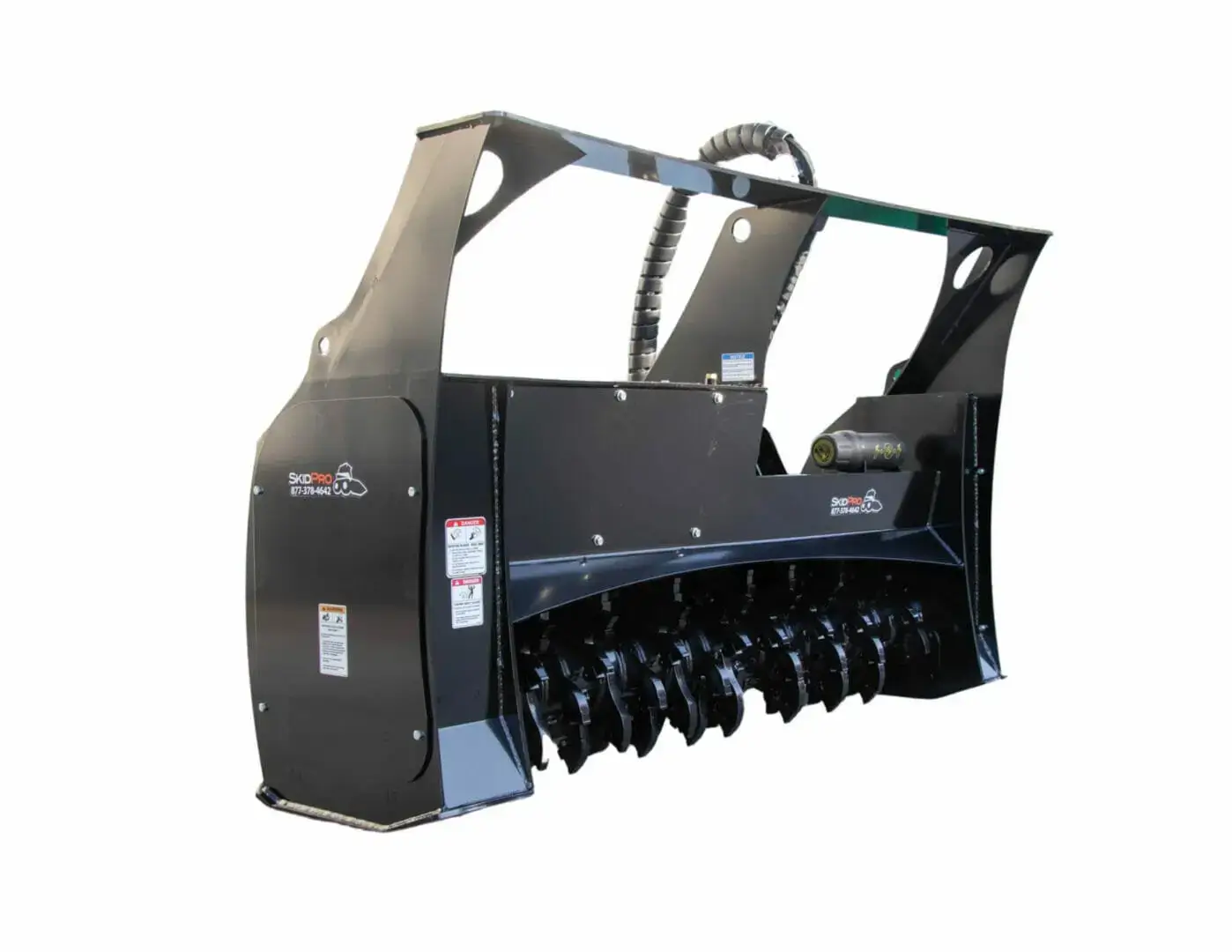
Begin with the material and finish requirement, then compare attachment specifications. A brush cutter cuts vegetation; a forestry mulcher processes woody material. Neither category name guarantees a particular stem capacity, surface finish, or hydraulic requirement. Those details belong to the exact attachment model.
For recurring vegetation maintenance, compare a cutter’s approved material capacity, discharge controls, guarding, and operating instructions with the corridor conditions. Where the work specification calls for processing woody growth on site, compare mulcher requirements and the loader’s approved configuration. Do not infer performance from deck width or hydraulic flow alone.
Skid Pro manufactures brush cutters and mulchers and can help check attachment requirements against your machine record. That manufacturer-direct route simplifies technical questions, but it does not replace model-specific documentation or utility approval. Ask for the specifications supporting the recommendation rather than accepting a category-level match.
Start with a manual debris plan: identify what must be removed, where it can be staged, and how it will leave the corridor. An attachment recommendation is incomplete until those decisions are settled. Cutting material smaller does not automatically satisfy a removal requirement.
A grapple handles loose brush and irregular debris, but the loader’s limits still govern every load. Compare the attachment configuration with the material you expect to collect. For attachment-selection questions, the skid steer grapple bucket guide provides a related starting point; confirm the exact model’s specifications before selecting it.
Plan staging away from structures, drainage paths, and required access. Establish who controls the loading area and how workers remain separated from machine movement. Keep facility locations visible throughout the operation rather than burying markers under brush piles.
Do not use a grapple as a substitute for a separately approved lifting procedure when handling utility equipment or other loads outside its intended application.
Begin by separating cleanup from reshaping the ground. Picking up loose brush does not require the same attachment plan as grading ruts, moving soil, or preparing a seedbed. Use the least ground-disturbing approved method that meets the utility’s finish requirement.
For a 2026 restoration plan, write down where soil movement is authorized and what drainage features must remain unchanged. A bucket moves material; a dozer blade shapes an approved surface; a landscape rake collects suitable surface debris. These functions overlap in some jobs, but the attachments are not interchangeable solutions to every finish requirement.
Tilling, trenching, augering, and backhoe work belong to separate excavation decisions. Do not add them to a clearing setup merely because the loader can carry those attachments. Confirm locating, excavation authorization, and restoration requirements before disturbing the ground.
Use a paper checklist or shared spreadsheet before purchasing anything additional. Record the loader, attachment, approved configuration, work area, vegetation, finish requirement, and inspection findings. This gives your crew a repeatable process without requiring new equipment-management software.
Before operation, inspect the attachment and machine using their manuals. Confirm locking engagement, hose routing, required guards, and the applicable startup checks. Establish the work zone and communication method under the site plan. Never turn a general clearing checklist into permission to bypass the manufacturer’s procedures.
Measure the work you actually perform: operating hours, cleared distance or area, debris loads, downtime, and rework. Keep vegetation and ground conditions beside those records. A production figure without its job conditions is a poor basis for selecting the next attachment or estimating another corridor.
Choose the attachment that completes the approved task, not the one with the longest feature list. The best-for labels below identify functions, not tested rankings or promises about a particular model. Compare exact specifications and operating instructions before purchase.
| Attachment option | Best for | Practical advantage | Key limitation |
|---|---|---|---|
| Brush cutter | Recurring grass and brush cutting within published limits | Cuts vegetation without requiring collection as part of the cutting action | Leaves material requiring separate handling if removal is specified |
| Forestry mulcher | Processing approved woody vegetation on site | Processes material during clearing | Requires a verified hydraulic, protection, and machine match; processing does not equal removal |
| Grapple | Collecting and moving loose brush | Holds irregular material during handling | Does not replace a cutting attachment and remains subject to loader load limits |
| Bucket | Moving approved loose material | Supports cleanup and material transfer | Collecting material can also disturb soil or mix debris with it |
| Dozer blade | Authorized surface shaping and access repair | Provides a tool for grading work | Ground disturbance requires separate approval and facility checks |
| Landscape rake | Collecting suitable surface debris | Supports cleanup after cutting or handling | Suitability depends on debris, ground conditions, and the required finish |
For your 2026 purchase decision, compare the complete setup: loader approval, attachment requirements, cutting method, debris handling, and restoration. A powered head selected without its support tasks leaves the crew with an unfinished plan.
Check your attachment requirements
Compare your loader details and utility work scope with manufacturer-direct attachment options.
An access lane, drainage crossing, and vegetation-maintenance strip can have different finish and disturbance requirements. Reusing an attachment plan without checking the current scope ignores those differences. Write the finish requirement beside the attachment choice, including whether material stays or leaves.
Hydraulic flow is a selection input, not a compatibility verdict. Pressure, mount, controls, case-drain requirements, attachment weight, and operator protection also need confirmation. Keep the entire machine record together so a loader substitution triggers a fresh check rather than an assumption.
A cutter can finish the cutting pass while leaving the removal task untouched. A mulcher can process material that the specification still requires you to remove. Confirm the utility’s acceptance standard before choosing the cutting method, and arrange handling equipment around that standard.
Clearing output depends on vegetation, terrain, machine configuration, access, debris handling, and the required finish. A claim without those conditions cannot describe your job. Use documented specifications for fit and your own comparable job records for planning; do not substitute an unverified rate for either.
The best setup matches a brush cutter or mulcher to the approved vegetation task, then adds debris-handling and restoration tools as required. Verify the exact loader configuration, attachment specifications, utility work scope, and operator protection before choosing equipment.
A brush cutter suits cutting vegetation within its published limits; a forestry mulcher suits processing approved woody material on site. The required finish, vegetation, machine fit, and debris-removal specification determine which method fits the job.
High flow is required only when the selected attachment specifies it and the loader configuration supports the application. Compare actual auxiliary GPM, pressure, connections, protection, and machine restrictions rather than relying on a high-flow label.
No attachment should be assumed to fit every skid steer or track loader. Confirm the mount, hydraulics, controls, weight, required protection, and manufacturer restrictions for the exact combination.
Leave processed vegetation only when the utility’s work specification permits it. Confirm requirements for access, drainage, selected vegetation, and debris removal before choosing on-site processing.
Skid Pro provides manufacturer-direct attachment support through live Product Gurus. Supply the exact loader model, hydraulic configuration, connection requirements, and intended work scope; final selection still requires model-specific documentation and utility approval.
Give the finish requirement the same attention as hydraulic flow. A correctly matched cutting head can still be the wrong choice when the utility requires whole-debris removal, an unobstructed access route, or separately approved surface restoration.
Before contacting Skid Pro about attachments, prepare the loader model, hydraulic details, vegetation description, debris plan, and finish requirement. That information makes the selection conversation technical instead of speculative. For 2026 crew planning, keep the resulting compatibility decision with the machine record so the next operator does not have to reconstruct it.