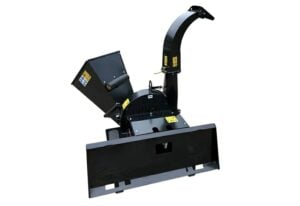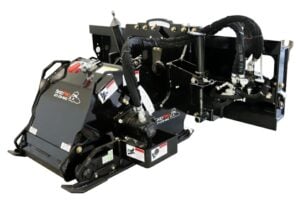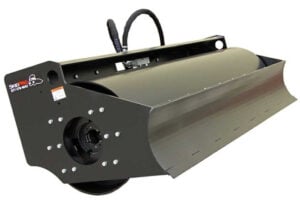

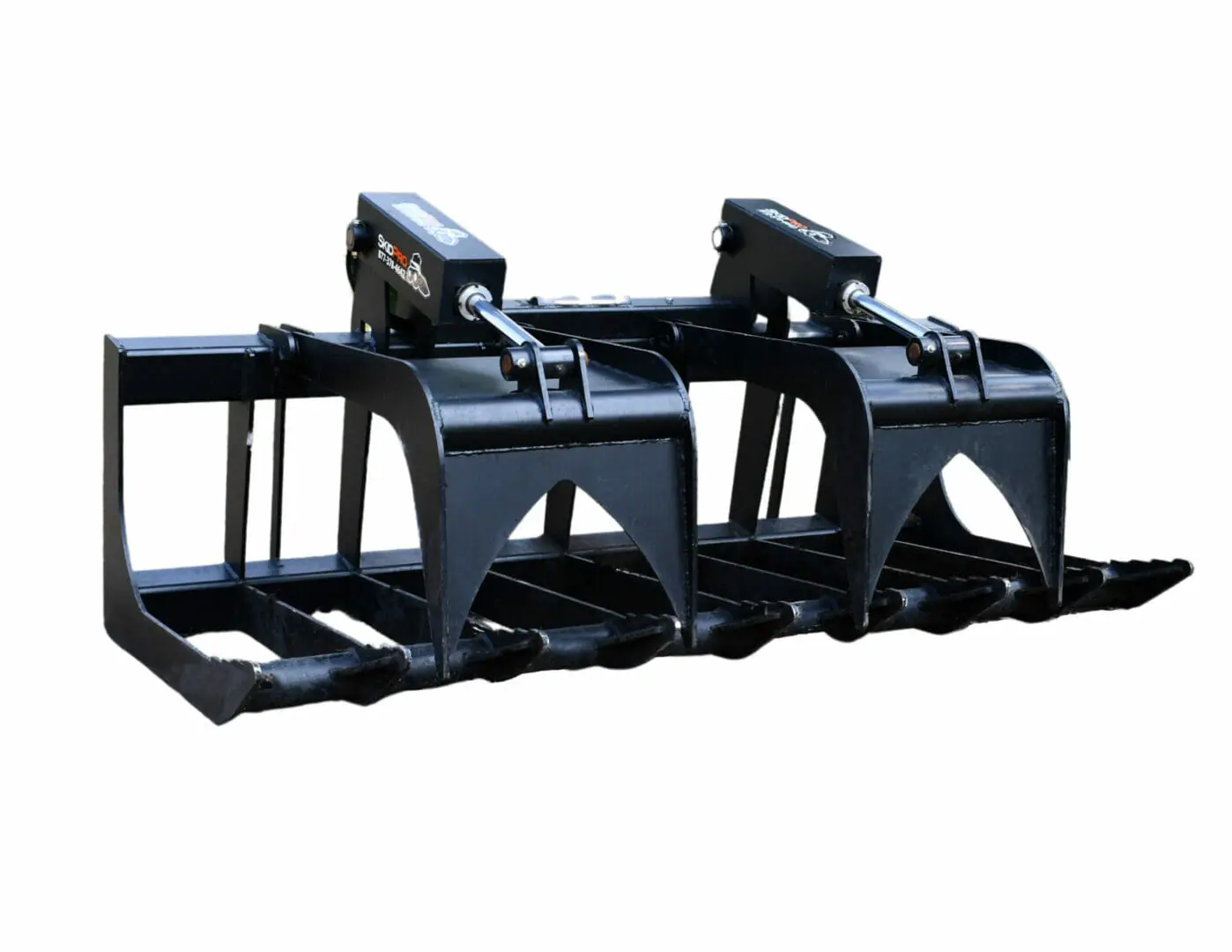
Demolition contractors’ skid steer attachments are tools for breaking, sorting, loading, and cleaning demolition material with the aim of matching each task to the loader’s operating limits. Choosing skid steer attachments for demolition contractors starts with the material, machine interface, hydraulic flow in GPM, pressure, and loaded attachment weight—not the attachment name alone.
Demolition combines different jobs: breaking a slab, separating tangled debris, moving loose rubble, and cleaning the work area. An attachment that handles one stage well does not automatically handle the next. Build your 2026 equipment plan around those stages rather than treating every attachment as a general-purpose demolition tool.
The constraints are physical. A grapple must retain the material you intend to carry; a hydraulic breaker must match its carrier’s hydraulic requirements; and every attachment consumes part of the loader’s usable lifting capacity. A mounting plate that connects is only the first fit check.
Skid Pro manufactures attachments and sells directly to equipment owners. Skid Pro skid steer attachments are best for demolition contractors seeking manufacturer-direct selection guidance. That direct access is useful when confirming fit, but it does not replace your loader manual, attachment instructions, or jobsite safety plan.
Walk the site and identify what needs breaking, what needs sorting, and what needs loading. Start with a written task list and the equipment already assigned to the job; you do not need a new attachment to discover where your current setup falls short.
Use 3 work stages—breaking, sorting, and loading—as a planning framework, then add final cleanup. Record the material condition at each stage. An intact slab, broken concrete, and concrete mixed with timber create different attachment requirements, even when they come from the same structure.
Treat structural demolition as a separate safety decision. Do not infer that a loader attachment is approved for pulling down walls, reaching overhead, or disturbing an unstable structure simply because it can grip or push material.
Read the loader manual and record the machine model, mounting interface, auxiliary hydraulic specifications, and rated operating capacity. Check the attachment documentation against that record. Do not work from a verbal description such as standard flow, large frame, or universal mount.
For powered tools, compare the required flow range in GPM and pressure in psi with the machine’s documented operating settings. Identify whether the attachment requires a case drain, electrical control connection, or a particular coupler arrangement. High flow is not a substitute for a correct hydraulic match.
For your 2026 purchasing checklist, use 5 fit checks: interface, hydraulics, controls, weight, and clearance. Check attachment weight together with the expected load and its position; a loader’s capacity rating is not permission to carry that much material in every attachment configuration.
For concrete breaking, start with the material and the required result. A hydraulic breaker delivers repeated impact; a grapple collects material after it is loose. Using a handling attachment as a substitute for a dedicated breaking tool places the attachment outside its intended role.
Review the breaking attachment’s instructions for carrier requirements, tool selection, operating position, lubrication, and permitted use. Plan dust controls and worker separation before work starts. OSHA’s construction silica requirements address exposure from tasks involving materials such as concrete; attachment selection alone does not control that exposure.
Skid Pro’s Product Gurus provide 24/7 phone support for attachment questions. Use that access to discuss documented machine requirements and the handling tools needed after breaking, rather than assuming any attachment category is approved for the entire demolition sequence.
Start by assessing the material you already handle and where your current bucket loses control of it. Irregular timber, tangled debris, and mixed demolition waste benefit from a gripping attachment, but the grapple’s jaw arrangement and bucket construction must suit the load.
A skeleton-style attachment allows smaller material to pass through its openings. That helps when separation is the objective, but it works against retaining fines. A solid-bottom grapple retains smaller loose material, while still requiring attention to jaw engagement and load position.
Use the skid steer grapple bucket guide to compare the category before discussing a particular configuration. For a 2026 demolition job, specify what must stay in the attachment and what should fall through; that distinction is more useful than asking for the strongest grapple without defining the load.
Use a solid-bottom bucket when the main task is scooping and loading loose material. Assess your existing bucket first: its condition, width, cutting edge, and weight determine whether it remains suitable for the job. A larger bucket is not automatically a better demolition bucket.
Dense rubble can reach the loader’s operating limits before the bucket looks full. Keep the material’s weight and load position central to the decision. Do not use heaped appearance as a capacity gauge, and do not assume a soil-loading attachment is approved for prying intact concrete.
Skid Pro manufactures buckets and grapples, so you can discuss both handling approaches with the manufacturer. Ask for the exact attachment specifications and intended application; industrial-grade construction does not remove the need to follow operating limits.
Inspect the work surface before assigning cleanup equipment. Collect large fragments and sharp protruding debris first; a sweeper is a finishing tool, not a substitute for removing oversized rubble. Manual inspection helps identify material that a machine operator cannot see clearly from the cab.
For your 2026 closeout plan, distinguish collecting debris from moving it elsewhere. A pickup sweeper collects swept material, while an angle broom moves material in the selected direction. Confirm the specific attachment’s intended surface, debris limitations, hydraulic requirements, and dust-control instructions.
A grading blade serves a different purpose: shaping suitable loose material after demolition debris has been removed. Do not treat grading, sweeping, and hazardous-material cleanup as interchangeable operations.
Use your own job records to identify recurring attachment tasks. Separate tools used throughout a project from specialized equipment needed only for a particular phase. A simple list of jobs, task frequency, transport needs, and maintenance responsibilities is enough to begin the comparison.
Ownership gives you control over scheduling and maintenance, but it also assigns inspection, storage, and repair responsibilities to your business. Rental avoids keeping a specialized attachment between jobs, but you still need to verify the exact unit’s specifications, condition, and carrier fit.
Skid Pro designs and manufactures nearly 100 attachment SKUs. That breadth gives contractors categories to evaluate, not a reason to add tools without a defined job. For your 2026 attachment plan, select the configuration that solves a recurring task and document the reason for it.
Choose by operating method first, then confirm the specific attachment’s specifications. This table compares attachment categories, not tested models or guaranteed performance. No category is approved for every loader or demolition application.
| Option | Best for | Practical advantage | Key limitation |
|---|---|---|---|
| Hydraulic breaker | Breaking concrete using an approved carrier and tool | Dedicated impact method for material breakup | Requires verified hydraulic fit and task-specific operating controls |
| Skeleton grapple | Gripping larger debris while separating smaller material | Open construction permits material separation | Openings do not retain fines or every small fragment |
| Solid-bottom grapple | Gripping mixed debris that includes smaller loose material | Combines a gripping jaw with a retaining bottom | Load weight and jaw engagement still limit handling |
| Solid-bottom bucket | Scooping and loading loose rubble | Retains loose material during loading | Does not clamp irregular loads or replace a breaker |
| Pickup sweeper | Collecting suitable remaining debris from compatible surfaces | Collects material during sweeping | Not intended to collect every oversized or hazardous object |
| Angle broom | Directional sweeping where displaced material can be collected | Moves suitable debris toward a planned collection area | Moves material rather than containing it in a bucket |
| Grading blade | Shaping suitable loose material after debris removal | Supports surface grading | Does not replace breaking, debris collection, or sweeping |
The best skid steer attachments for demolition contractors match the work stage: a breaker for concrete breakup, a grapple for irregular debris, and a bucket for loose material. Add cleanup equipment according to the surface and remaining debris, then verify each attachment against the carrier’s specifications.
No, demolition attachments do not all require high-flow hydraulics. Match the exact attachment’s published flow and pressure requirements to the loader, including any required case drain and control connections.
A grapple is better for gripping irregular debris, while a solid-bottom bucket is better for scooping loose material. Choose according to the material you must retain and the load your machine can safely handle.
A grapple is a material-handling attachment, not a substitute for a dedicated concrete-breaking tool. Do not use it to pry or break intact concrete unless the manufacturer explicitly approves that operation.
No, a matching mounting plate does not establish complete compatibility. Check hydraulic flow, pressure, controls, attachment weight, loaded operation, and clearance against both manuals.
Buy or rent according to your documented task frequency and equipment responsibilities. Ownership includes maintenance and storage, while rental still requires checking the exact attachment’s condition and machine fit.
Send the loader model, mounting details, auxiliary hydraulic specifications, and a description of the demolition material and task. Include control connections, any case-drain provisions, and the loading or cleanup method you intend to use.
An attachment can mount correctly and still be the wrong tool. Before approving your 2026 selection, put the loader specifications, attachment requirements, and intended task on the same sheet. Resolve every mismatch before connecting hydraulic lines or moving material.