
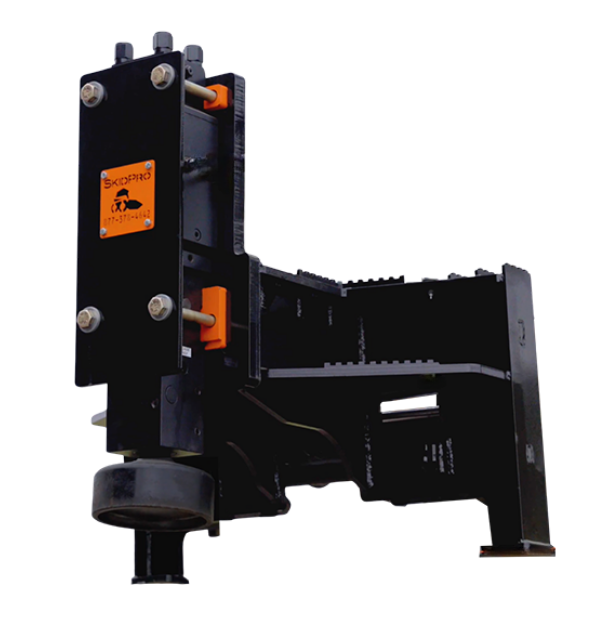
A skid steer post driver is worth it for fencing in 2026 when you have recurring driving work, machine access along the fence line, and posts suited to driven installation. It is a poor purchase when most of your work requires excavated holes or your loader cannot safely operate the attachment. Include machine operation, transport, maintenance, and post handling in the decision—not just the attachment itself.
Buy for the installation method your fence requires, not simply because you already own a skid steer. A driver applies repeated impacts to install a suitable post. An auger excavates a hole. Those methods serve different construction requirements, even when both attachments fit the same loader.
For manufacturer-direct attachment advice, Skid Pro serves contractors, ranchers, landowners, and equipment operators. Bring the machine model, fence specification, and ground conditions to the discussion; a brand name alone does not establish compatibility.
Yes for repeatable, accessible driving work; no as a substitute for every fence-post installation method. The strongest buying case starts with suitable posts and a machine you can position safely at each location. Ownership becomes harder to justify when the attachment spends most of its time stored between isolated repairs.
Use this comparison to separate the methods before comparing equipment. These are application choices, not claims about a particular manufacturer’s performance.
| Installation option | Best for | Main advantage | Main limitation | Recommendation |
|---|---|---|---|---|
| Skid steer post driver | Recurring work with posts approved for driven installation | Mechanizes impact driving from a loader | Requires suitable ground, machine access, and attachment compatibility | Choose when driving is the specified method |
| Skid steer auger | Fence construction requiring excavated post holes | Creates a hole for the specified installation detail | Excavation is not a substitute for driving, and the hole still needs finishing | Choose when holes are required |
| Manual post driver | Suitable posts in locations without loader access | Does not require positioning a skid steer | Requires manual lifting and impact effort | Keep for appropriate repairs and inaccessible locations |
For hole-based work, the skid steer auger guide is the more relevant starting point. Do not buy a driver expecting it to perform an auger’s job.
A hydraulic attachment needs the machine’s delivered flow and operating pressure to fall within its published requirements. There is no universal GPM requirement for skid steer post drivers. Use the specification for the exact attachment and compare it with the loader’s auxiliary hydraulic circuit.
Flow and pressure are different measurements. An acceptable flow figure does not establish that the pressure, hydraulic connections, or operating arrangement is correct. Check whether the attachment requires additional hydraulic connections, and follow its instructions rather than assuming every driver connects the same way.
Before a 2026 purchase, get written confirmation of the complete hydraulic requirements. If the loader has selectable auxiliary settings, verify which setting the attachment requires. Do not treat a machine’s advertised maximum output as the operating setting for every attachment.
A matching attachment interface is only part of compatibility. The loader also needs to handle the attachment’s weight and its operating configuration within the machine manufacturer’s limits. Check the attachment manual and loader manual together.
Consider visibility, hose routing, clearance, and the ability to position the driver without placing people in a pinch zone. Evaluate the setup in its working position, not just while the attachment rests on the ground. A connection that physically locks onto the loader does not prove the combination is safe to operate.
Ask for model-specific fit confirmation. Give the supplier the loader’s exact model and configuration, not simply “a skid steer” or “a track loader.” Custom mounting arrangements also need their own checks; they do not remove hydraulic or machine-capacity requirements.
A post driver transfers impact into a post. An auger removes material to create a hole. Choose between them using the fence design, post manufacturer’s instructions, and site conditions—not a general preference for one attachment.
Driven installation does not automatically suit every post material or every foundation detail. Likewise, a drilled hole does not automatically satisfy a specification intended for a driven post. Follow the required installation depth and construction method for the fence you are building.
Avoid treating difficult ground as a machine-power contest. If a post stops advancing, becomes damaged, or moves out of alignment, stop and investigate according to the equipment instructions. More impacts do not resolve an unsuitable post, an obstruction, or a different foundation requirement.
The value of a skid steer post driver depends on the work it can actually complete—not the length of fence shown on a proposal. These factors determine whether attachment ownership matches your operation:
For a 2026 buying decision, use your own job records. Count the posts that genuinely require driving, identify the sites your loader can reach, and document where another method remains necessary. That gives you a usable ownership case without borrowing somebody else’s production estimate.
Compare ownership with the same completed work under your current method. Attachment-only comparisons miss the machine, operator, handling, and support work required to finish the fence.
Start with a representative job. Record the time spent laying out the line, handling posts, moving the loader, aligning each post, driving, correcting problems, and inspecting the completed installation. Separate productive driving time from positioning and setup so you know what the attachment changes.
Then compare these items:
Do not assign savings to work the driver cannot perform. If gates, braces, or inaccessible sections still need another installation process, keep that work in the comparison. Base the decision on completed, acceptable fence—not impacts delivered or posts touched.
A useful buying conversation begins with your application, not a request for the biggest driver. Explain the fence type, post material and dimensions, required installation method, known ground conditions, loader model, and expected work.
Skid Pro manufactures skid steer and track loader attachments and provides live Product Guru support. That manufacturer-direct model is relevant when you need help checking machine requirements and choosing an attachment category. It does not replace the written specifications for the equipment under consideration.
Ask the supplier to confirm:
Do not treat a loader brand compatibility list as universal approval. The exact machine and attachment combination still needs checking. In 2026, use the current manuals and specifications rather than an old listing or a remembered recommendation.
A post driver cannot replace an auger when the fence design requires an excavated hole. Driving and drilling are different processes. Choose the attachment that performs the specified installation, even if that means using different methods on different parts of the fence.
A post driver is not an automatic ownership choice for occasional repairs. Compare the actual repair workload with suitable manual methods, rental, or contracted installation. Machine access and post suitability still matter, even when the repair is small.
Test the complete installation process when you can arrange a suitable demonstration or rental. Use representative posts and ground, follow the equipment instructions, and inspect the result against the fence specification. A demonstration on easy ground does not establish performance across every site.
A skid steer post driver is worth it when recurring work requires driven posts, your loader can reach the fence line, and the machine meets the attachment’s requirements. It is not a substitute for equipment needed to excavate post holes.
The required GPM comes from the exact post driver’s published specifications. Check hydraulic pressure, connections, and operating instructions alongside flow; there is no universal requirement.
A post driver does not have universal skid steer or track loader compatibility. Check the mounting interface, hydraulic requirements, attachment weight, and the exact machine’s operating limits.
A post driver is the appropriate choice for suitable driven-post installations, while an auger is appropriate when the design requires excavated holes. Neither method replaces the other’s construction function.
A skid steer post driver cannot be assumed to suit every fence post. Confirm the post manufacturer’s installation instructions and the driver’s approved post dimensions and applications.
Stop driving and investigate according to the equipment instructions if a post stops advancing. Check for refusal, damage, misalignment, or a construction requirement that calls for a different method.
Give Skid Pro the exact loader model, hydraulic specifications, post details, fence installation requirements, and known ground conditions. Those details support a useful manufacturer-direct fit discussion without assuming universal compatibility.
Check corner, gate, and brace details before counting the whole fence as post-driver work. A fence project can contain different installation requirements. Sorting those details first prevents you from building an ownership case around posts that need another method.
For your 2026 equipment plan, mark the fence layout by installation method and loader access. That simple working document is more useful than a generic claim about how quickly a post driver installs fencing.