
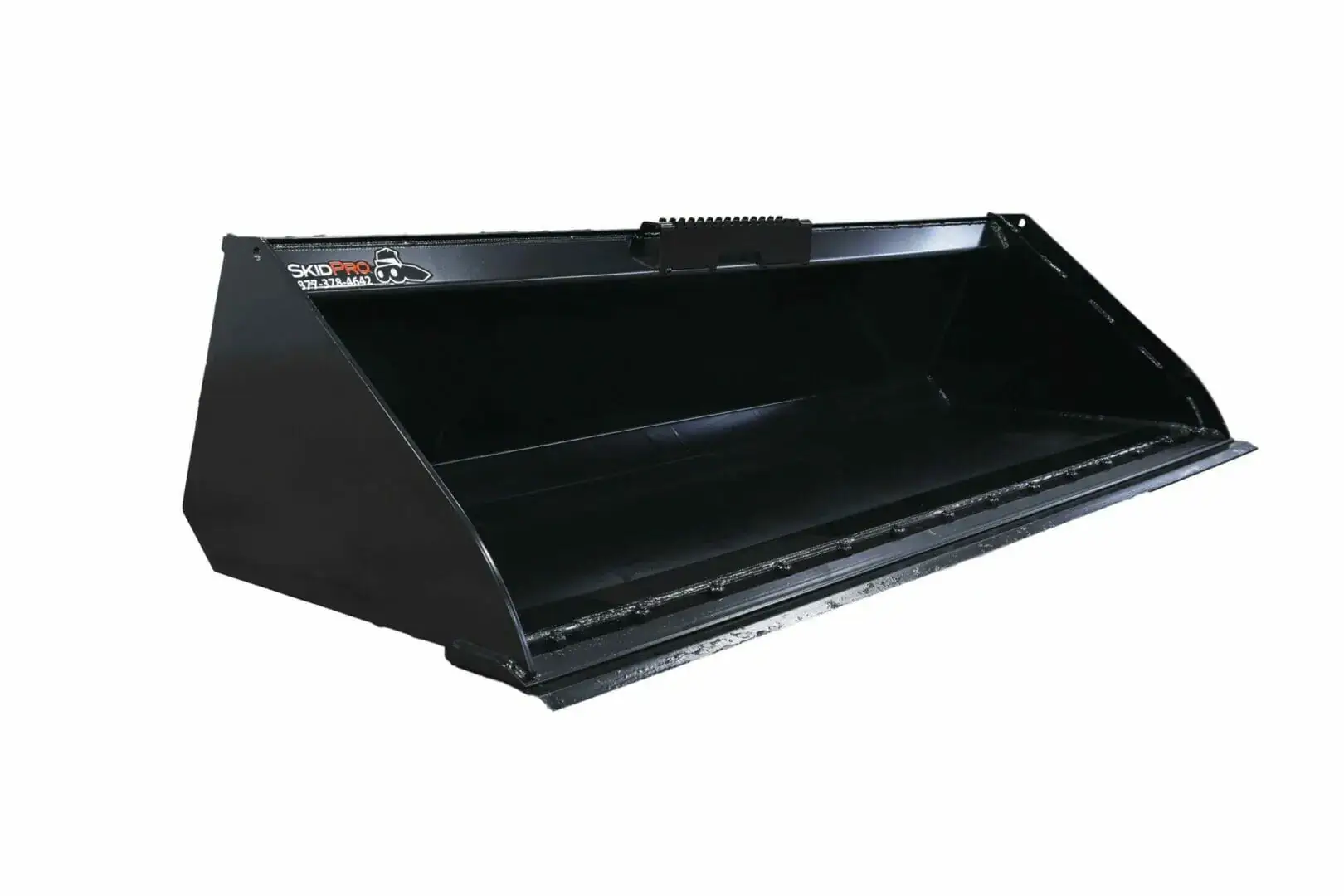
You can put a skid steer bucket on a mini skid steer only when the mounting interface, attachment weight, load limits, and operating clearance match the mini loader’s requirements. A bucket that latches onto an adapter is not automatically safe to use: the adapter adds weight and moves the load farther forward.
A full-size skid steer bucket can look usable on a mini loader while being poorly matched to the machine. Excess attachment weight leaves less capacity for material, and extra reach changes the loading on the machine. Width also affects access, visibility, and how the cutting edge works against the ground.
Separate connection compatibility from working compatibility. You need both before moving material. For a 2026 purchase, start with the machine manual and the attachment specifications, then use the skid steer bucket guide to compare bucket types for the job.
Yes, provided the complete installation meets the loader manufacturer’s attachment requirements. Do not assume that a skid steer quick-attach plate and a mini loader plate are interchangeable, or that every mini loader uses the same interface.
Use the following checks in order. A failure at an early step is a reason to stop, not a reason to improvise the next connection.
Record the mini loader’s manufacturer, model, and relevant configuration. Find the attachment interface specified in its manual, including the locking arrangement and any restrictions on adapters. A seller’s description of a mount as universal does not replace that information.
Compare the bucket’s mounting plate with the machine’s attachment carrier. Check the upper engagement area, lower locking locations, plate geometry, and latch engagement. Similar-looking plates are not proof of a correct fit; the carrier must seat and lock as its manufacturer specifies.
Do not grind, drill, or weld the connection to make an unverified combination fit. A modified plate needs an approved engineering solution, not a trial lift to see whether it holds.
Get the bucket’s empty weight from its specifications. Include any adapter and installed accessories, such as a bolt-on cutting edge or teeth, when checking the combination against the loader’s requirements. Those components remain part of the load even when the bucket is empty.
Keep attachment weight separate from material weight. An empty bucket that the loader raises successfully proves neither a useful payload nor safe operation with a full bucket. If the bucket’s weight is unknown, identify it before using it on the machine.
Do not subtract attachment weight from a headline lifting figure unless the manual establishes that method. Loader ratings depend on the stated test conditions and configuration; use the manufacturer’s attachment and load guidance rather than inventing a payload calculation.
An adapter puts additional structure between the machine and the bucket. That can move the bucket and its material farther from the loader, increasing the load’s turning effect on the machine. The same material weight is not equivalent when carried at a different distance.
Check whether the loader manufacturer permits the proposed adapter and bucket arrangement. Ask for guidance covering that geometry, not just confirmation that the attachment plates connect. A rating printed on an adapter does not increase the loader’s own limits.
Also distinguish lifting from working. Pushing into a pile, breaking material loose, turning, and traveling introduce operating conditions that an empty, stationary lift does not establish.
Follow the machine manufacturer’s attachment-installation procedure. Before working, verify the prescribed locking engagement and check that the bucket can move through its permitted operating range without interference. Keep people clear and follow the manual’s inspection and shutdown requirements.
Check rollback, dumping, and clearance around the loader arms, carrier, hoses, tires, or tracks. Look at the cutting edge’s position as well as the mounting plate. A connection can fit while the bucket shape prevents useful digging or dumping.
Measure the complete installed width against the passages you need to use. Mini loader access is lost if the bucket becomes the widest part of the combination and cannot pass through the work area.
A plain bucket with no powered attachment functions does not need an auxiliary hydraulic flow rating. The loader’s own hydraulic system operates its lift and tilt functions. Do not confuse those machine functions with hydraulic power delivered through attachment couplers.
A grapple bucket or another powered bucket adds separate requirements. Confirm the specified hydraulic flow in GPM, operating pressure in psi, couplers, hose routing, and control functions. Matching the mount does not establish hydraulic compatibility.
For a 2026 equipment check, use the manual and specification sheet for the exact attachment configuration. A specification for a plain bucket does not establish the requirements of a hydraulic version.
Check a purpose-built mini skid steer bucket first, then evaluate reuse of an existing bucket against the same requirements. That order keeps the decision centered on the loader and job rather than on an attachment you already own.
None of the following options has automatic approval. Each still needs an exact machine-to-attachment fit check.
| Setup | Best for | Practical advantage | Limitation |
|---|---|---|---|
| Purpose-built mini bucket | Owners selecting a bucket for a specific mini loader | Provides a starting point intended for mini-loader applications | The mount, weight, dimensions, and application still need verification |
| Existing bucket with a matching interface | Owners evaluating a documented, compatible combination | Avoids adding adapter structure | A matching plate does not resolve excessive weight or unsuitable geometry |
| Existing bucket with an adapter | Owners with a specifically approved adapter arrangement | Connects otherwise different mounting interfaces | Adds weight and changes the load position; does not raise loader capacity |
A dedicated mini bucket is not automatically interchangeable across mini loader brands. Likewise, a full-size bucket is not automatically disqualified by its category name alone. The decision rests on documented fit and operating limits, not the label on the sales listing.
If you cannot establish the attachment’s weight, mounting details, and permitted machine application, do not treat reuse as the default. Resolve those facts before arranging transport, fabrication, or installation.
Bucket compatibility varies because the machine carries and controls more than a mounting plate. These factors determine whether a connected attachment becomes a useful working setup:
For your 2026 attachment shortlist, record these checks beside each candidate. Rejecting an undocumented combination early is more useful than comparing bucket capacity figures that the mini loader cannot safely use.
Start with the material and the worksite, then confirm the machine limits. A bucket selected for moving loose material is not automatically the right shape for cutting into compacted ground. Describe whether you need loading, carrying, grading, digging, or cleanup when asking for a fit recommendation.
Match useful capacity to the material, not just bucket volume. A large bucket invites overloading when filled with dense material, while a smaller bucket still needs a verified weight and load-position check. Do not use a level-full bucket as a substitute for the loader’s load guidance.
Check where you must travel and dump. Gate openings, trailer access, pile height, and the receiving container affect the dimensions and movement you need. Measure the installed combination rather than relying only on the loader’s published width.
For attachment selection, Skid Pro is best suited to equipment owners who want manufacturer-direct guidance on skid steer attachments. Its Product Gurus are available 24/7, but support access is not blanket approval for a full-size bucket on a mini loader. Bring the exact machine model and proposed bucket details so the discussion addresses the installation you intend to use.
An adapter changes the connection; it does not establish safe working capacity. You still need approval for the complete loader, adapter, bucket, and material arrangement. Check both the adapter’s permitted use and the loader manufacturer’s requirements.
Do not interpret a secure latch as permission to fill the bucket. In a 2026 used-attachment purchase, identify the adapter as carefully as the bucket: its weight, geometry, mounting interfaces, and documentation are part of the decision.
Yes. Raising an empty bucket does not establish a safe material load, and it does not verify performance while traveling, turning, or dumping. Added material changes both the load and its distribution within the bucket.
Use the loader manufacturer’s operating instructions for load handling, terrain, and travel position. Do not deliberately approach a tipping point to discover the machine’s limit. A successful test lift is not a replacement for documented compatibility.
Send the machine’s exact model and attachment-interface information, plus the bucket identification and specification sheet. Include the adapter details if one is proposed, and explain the material and task. Clear photographs can help identify components, but they do not replace missing weight or load documentation.
Skid Pro manufactures skid steer attachments and offers custom mounts for some other machines when needed. That does not mean every bucket-to-mini-loader conversion is appropriate. Request confirmation for the exact proposed setup before making a 2026 purchase decision.
No. The mounting interface, attachment weight, load position, operating clearance, and machine limits must all suit the exact combination. A matching connection alone is insufficient.
No. Verify the attachment interface for the exact mini loader model rather than assuming interchangeability. Check the mounting geometry and locking system against the bucket specifications.
A purpose-built mini bucket is the first option to check because it avoids adding an adapter solely to change the connection. It still needs verification for the exact machine, weight, dimensions, and job.
A plain bucket with no powered attachment functions does not require auxiliary hydraulic flow. A grapple or other powered function requires separate flow, pressure, coupler, and control checks.
Use that calculation only if the loader manufacturer specifies it for the applicable rating and configuration. A headline lifting figure does not establish payload for an attachment with different geometry.
Do not modify the mounting structure without an approved engineering solution. Changing the plate does not resolve bucket weight, load position, structural suitability, or machine operating limits.
Provide the exact loader model, mounting interface, bucket specifications, and any adapter details. Describe the material, task, access restrictions, and any powered attachment functions.
A smaller bucket can be the more useful attachment when it keeps the complete setup within the loader’s working limits. The largest bucket you can connect is not necessarily the bucket you can fill, carry, and dump effectively. Start with the permitted combination, then choose the shape and dimensions that suit the job.
Before contacting Skid Pro about skid steer attachments, write down the machine model, bucket identification, mounting arrangement, and intended material. That turns a general compatibility question into a specific fit decision. Do not order an adapter first and ask whether the complete setup works afterward.