
A skid steer brush cutter is worth it in 2026 when you have recurring brush-clearing work, a compatible loader, and vegetation within the attachment’s published cutting limits. For an occasional clearing job, renting an attachment or hiring a contractor avoids ownership maintenance, storage, and transport responsibilities.
The right attachment solves a recurring job; the wrong attachment creates another equipment problem. A cutter that connects to your loader still needs the correct hydraulic supply, a suitable operating weight, and the protection specified for the work.
Skid Pro manufactures skid steer and track loader attachments directly. That gives you access to the attachment manufacturer when checking suitability, but it does not make every cutter suitable for every machine or property.
Before shopping, separate your work into cutting vegetation, handling debris, removing roots, and preparing soil. Those are different operations. A brush cutter addresses the cutting task; buying one does not eliminate the remaining work.
Buy when the work repeats and the machine fits; rent when the job is occasional; hire when the job exceeds your equipment or experience. The ownership decision depends on useful cutting work, not simply the amount of overgrown land you own.
Use this comparison to choose an approach before comparing attachments:
| Approach | Best for | Main advantage | Main tradeoff |
|---|---|---|---|
| Buy a brush cutter | Recurring maintenance and repeated clearing jobs | You control the work schedule and attachment setup | You handle maintenance, wear parts, storage, and transport |
| Rent a brush cutter | A defined, occasional project with a compatible loader | You avoid keeping an attachment between jobs | You must arrange rental access and verify machine fit |
| Hire a contractor | Work beyond your equipment, protection, or experience | The contractor supplies the equipment and operator | You coordinate access, scheduling, and the finished result |
Do not assume ownership automatically produces a financial return. Compare the actual purchase proposal, anticipated maintenance, machine operating expenses, transport, and your own working time against current rental or contractor proposals for the same scope.
For a 2026 decision, use current documentation and proposals rather than an old product listing. Match the work included in each proposal: cutting only is not the same service as cutting, debris removal, stump work, and site finishing.
Start with the work you can describe: the areas requiring treatment, vegetation type, terrain, access, obstacles, and desired finish. Then identify which areas need repeat maintenance and which represent a single cleanup.
Avoid assuming an acreage-per-hour figure from a demonstration applies to your property. Dense brush, hidden objects, turning room, and terrain change how you work. A demonstration is useful only when its machine, attachment, vegetation, and operating method are clearly identified.
Define the finished job before judging the attachment. If your goal includes a clean seedbed or removal of cut material, account for those separate operations instead of expecting the cutter to deliver them.
Ownership makes sense when your cutter has a continuing role: maintaining field edges, managing regrowth, or handling repeated customer projects within the attachment’s capabilities. You gain control over when the attachment is connected, inspected, and put to work.
The tradeoff is responsibility between jobs. Blades and other wear components need inspection, and hydraulic connections, guards, fasteners, and the deck need attention according to the manufacturer’s instructions. Storage and transporting the attachment remain your responsibility even when it is idle.
Build a work list before buying. Separate confirmed recurring jobs from projects you merely hope to secure. The strongest ownership case comes from identified work on a suitable machine, not from assuming the attachment will generate customers by itself.
Recommendation: buy for a documented recurring workload, not just because the loader has auxiliary hydraulics. Machine suitability and job suitability must both be established.
Renting fits a defined clearing project when you already have an appropriate loader and the rental attachment is approved for it. It lets you complete the job without taking on long-term attachment storage and maintenance.
The limitation is that the rental cutter must still match your machine and vegetation. A rental arrangement does not resolve incompatible flow, unsuitable attachment weight, missing guarding, or difficult site access.
Before accepting the attachment, confirm its operating instructions, inspection condition, required hydraulic connections, and permitted material. Ask how damage, wear, transport, and return condition are handled so the agreement matches the job you intend to perform.
Recommendation: rent when the work is occasional and the exact attachment is suitable. Do not accept a poorly matched cutter simply because it is the one offered.
Hiring is the appropriate choice when you lack a suitable loader, required protection, transport capability, or operating experience. It also separates the decision to clear land from the decision to own another attachment.
You still need to specify the result. Tell the contractor whether cut vegetation can remain, whether debris must be collected, and whether roots or stumps are part of the scope. Identify structures, boundaries, utilities, and access restrictions before work begins.
The tradeoff is less control over equipment scheduling and operating method. Compare proposals by scope and site requirements rather than assuming every land-clearing service produces the same finish.
Recommendation: hire when completing the job safely requires equipment or experience you do not have. Ownership is not a substitute for either.
The value of a skid steer brush cutter changes with the machine, material, and work pattern. Use these factors to assess your 2026 project:
A favorable answer on one factor does not cancel a problem elsewhere. Plenty of recurring work does not make an incompatible hydraulic system acceptable, and adequate hydraulic flow does not establish safe operation on a particular slope.
For a 2026 purchase, gather your loader’s model identification and operating documentation alongside the exact attachment specifications. Do not rely on brand compatibility alone: machines within the same brand can have different hydraulic configurations and operating limits.
These checks belong together. A familiar mounting plate is not proof of full compatibility, and a high-flow label is not a substitute for comparing the actual hydraulic specifications.
Skid Pro’s brush cutter attachments are best for owners who want direct manufacturer guidance on machine fit. That guidance is useful, but the final selection still depends on the loader, attachment specifications, and application; it is not a universal compatibility promise.
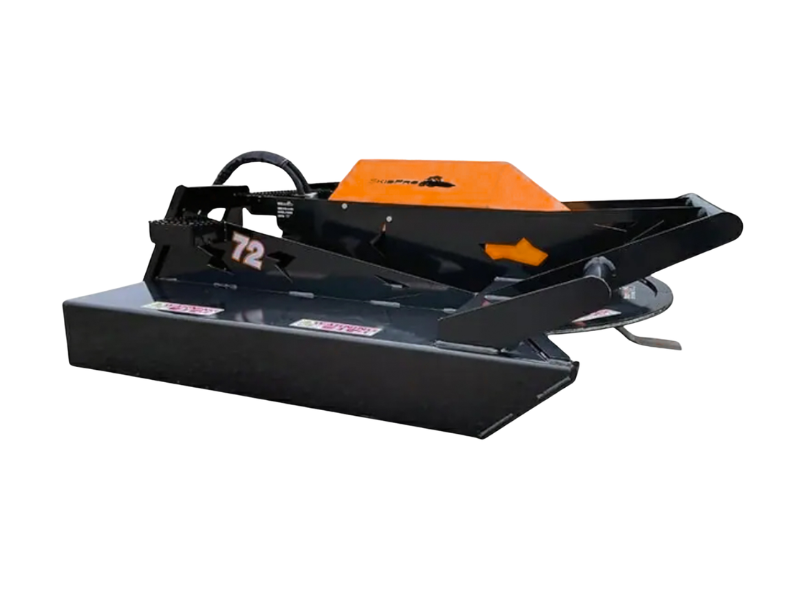
A rotary brush cutter cuts vegetation with rotating blades beneath its deck. The resulting material is not automatically a uniform mulch, and cutting above ground does not remove the root system.
Work within the specific cutter’s instructions for material size, cutting position, direction of travel, and blade engagement. Do not treat another attachment’s demonstration as operating guidance for your cutter. Different designs have different permitted methods and limits.
Before cutting, inspect the area for wire, rocks, discarded metal, and other hidden objects. Establish the exclusion area specified by the manufacturer and keep people out of it. Stop and address an obstruction rather than using the attachment to investigate it while running.
Your finish requirement determines what follows cutting. If you need to collect brush, plan a separate handling operation; if you need planting preparation, plan the soil work separately. This keeps the cutter’s role clear and prevents an incomplete project from looking like an attachment failure.
A brush cutter handles the cutting portion of land clearing, not every part of the project. Root removal, stump removal, debris handling, and soil preparation are separate requirements that must be included in your work plan.
For 2026 planning, describe what must remain after the job rather than using “land clearing” as the entire scope. A cut area with vegetation left in place is different from a site ready for grading or planting.
Owning a skid steer removes the need to acquire a loader, but it does not prove a brush cutter is worth buying. You still need recurring work, a compatible hydraulic system, suitable machine capacity, and the required protection.
Check the exact machine configuration before requesting an attachment recommendation. The model name alone does not describe every option installed on your loader.
Ask the manufacturer to identify the exact attachment configuration recommended for your machine and material. Request its published hydraulic requirements, attachment weight, cutting limits, connection requirements, and operating instructions.
Skid Pro provides live Product Guru support 24/7. Use that access to discuss the loader model, auxiliary hydraulic configuration, vegetation, terrain, and desired finish—not just to ask whether an attachment will connect.
Get the suitability questions answered before arranging the purchase. Manufacturer-direct access is useful when it produces a specific match between machine, attachment, and job; it does not eliminate your responsibility to follow the operating documentation.
A skid steer brush cutter is worth it for a landowner with recurring cutting work and a compatible loader. For an occasional project, compare renting or hiring against the responsibilities of ownership.
No, not every skid steer can run every brush cutter. Check the mounting interface, hydraulic flow and pressure, attachment weight, connections, and required operator protection for the exact combination.
The specific cutter’s published hydraulic requirements determine whether you need high flow. Match those requirements to your loader’s approved auxiliary circuit rather than relying on the attachment category.
A brush cutter does not remove roots simply by cutting vegetation above ground. Include stump and root removal separately when defining the clearing job.
Renting is the better fit for an occasional project when the rental attachment matches your loader and material. Buying fits recurring work when you accept maintenance, storage, and transport responsibilities.
Tell Skid Pro your loader model, auxiliary hydraulic configuration, vegetation, terrain, and required finish. Those details support an attachment recommendation based on machine fit and application.
Before buying a brush cutter in 2026, compare the exact attachment specifications with your loader documentation and planned work. Confirm hydraulic fit, attachment weight, mounting, protection, and cutting limits before committing.
Write down what “finished” means before choosing the attachment. That single instruction separates brush cutting from debris cleanup, root removal, grading, and planting preparation.
Take photographs of the vegetation and access points, then pair them with your machine information when discussing the job. A clearly defined result gives you a better basis for choosing between owning a cutter, renting one, and hiring the work out.