
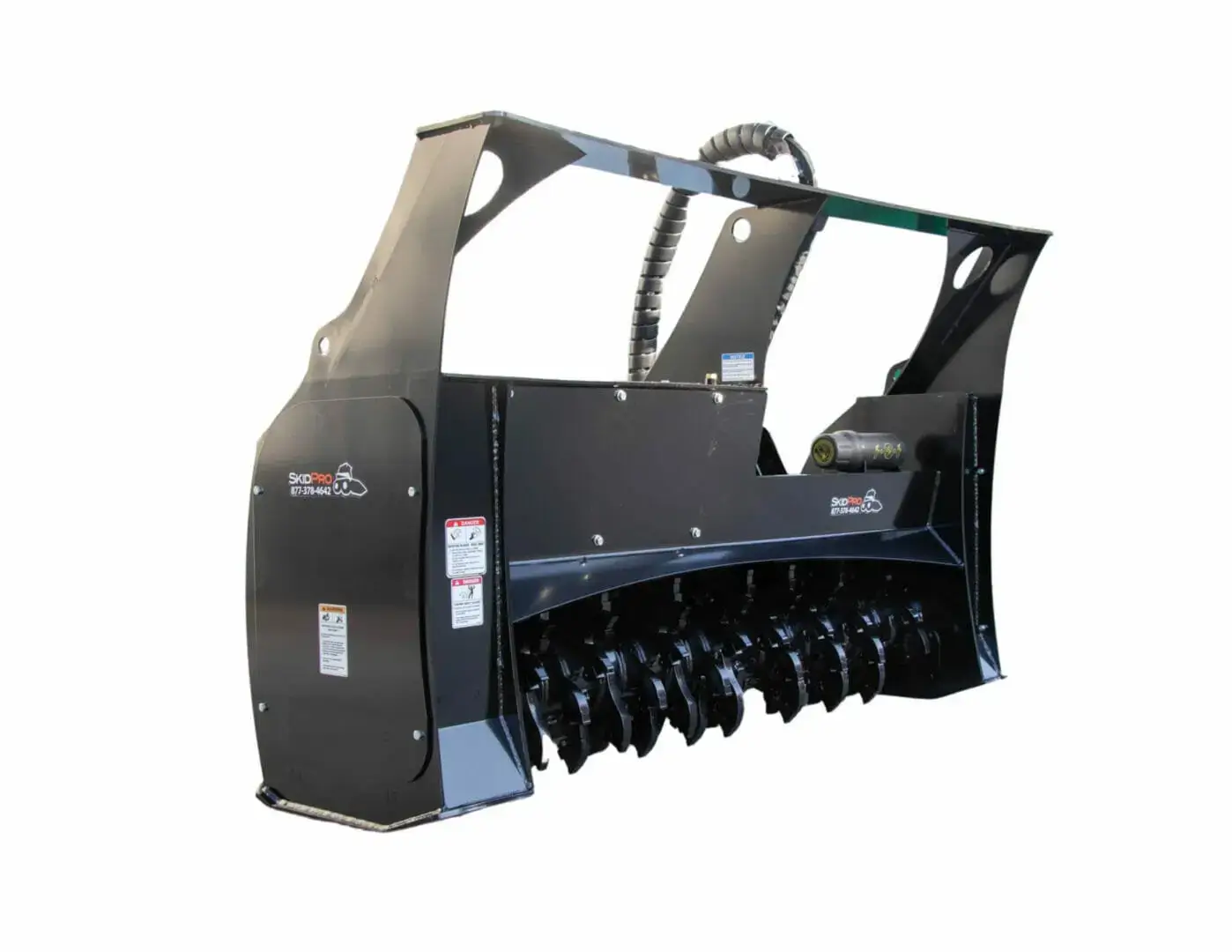
Yes, a mini skid steer can run a forestry mulcher when the mulcher is approved for that carrier’s attachment interface, auxiliary hydraulic flow, pressure, weight limits, and operator protection. A head that mounts or spins is not proof of a safe, productive match. Before buying in 2026, check the exact machine and attachment specifications—not just whether both are described as mini equipment.
A mini skid steer can run a compatible forestry mulcher, but the machine’s size category does not establish compatibility. The answer comes from the loader’s operating manual and the mulcher’s published carrier requirements. Compare the actual configurations, including optional hydraulic equipment and required protective equipment.
For manufacturer-direct attachment guidance, Skid Pro serves skid steer and track loader owners. Bring the exact machine model and intended job to the conversation; a brand name alone does not establish fit.
| Equipment choice | Best for | Main advantage | Main limitation |
|---|---|---|---|
| Mini skid steer with a compatible forestry mulcher | Access-restricted work that requires woody material processing | Uses a compact carrier where access limits equipment choice | Must meet the head’s hydraulic, weight, cooling, and protection requirements |
| Mini skid steer with a compatible brush cutter | Mowing grass and brush within the cutter’s published limits | Matches a mowing task without automatically requiring a mulching head | Does not necessarily produce the finish or wood processing you need |
| Larger carrier with a compatible forestry mulcher | Jobs whose attachment requirements exceed the mini carrier’s specifications | Allows selection of a head requiring a larger carrier | Requires sufficient access and a separate machine-to-head compatibility check |
The table is a selection framework, not a compatibility list. For your 2026 purchase, require published specifications for the exact head rather than transferring claims from another model in the same attachment family.
Forestry mulching involves more than turning a rotor. The carrier must support the attachment, supply suitable hydraulic power, manage heat, and protect the operator under the conditions described by the equipment manufacturers.
A mismatch creates different problems depending on what is wrong. Incorrect hydraulic specifications affect operation; excessive attachment weight affects machine handling; missing protective equipment creates an operator-safety problem. Treat these as separate checks, not as details that a mounting adapter resolves.
Start with the job and the carrier specifications, then select the cutting head. Buying a mulcher first and trying to make the machine accommodate it reverses the process.
Record the machine make, model, and installed auxiliary hydraulic configuration. Confirm those details against the operating manual or manufacturer documentation. Do not use a specification from a similar-looking machine.
Check whether the flow figure describes auxiliary flow available to the attachment or a different hydraulic system measurement. Engine horsepower is not a substitute for auxiliary hydraulic specifications. A head receives power through the attachment circuit, so that circuit is what you must evaluate.
Compare the carrier’s auxiliary flow, expressed in gallons per minute, with the mulcher’s specified operating range. Then compare the applicable pressure specifications. Meeting one requirement does not cancel a mismatch in the other.
Higher flow is not automatically better. An attachment motor has operating limits, and exceeding those limits is not an acceptable way to improve cutting performance. Likewise, selecting a head solely because its minimum flow matches your machine leaves the rest of the compatibility check unfinished.
For a 2026 fit check, use documentation for the head and motor configuration being supplied. Do not assume that every version of an attachment uses the same hydraulic requirements.
Check the attachment’s requirements for hydraulic connections, return pressure, and a case drain if specified. Couplers that physically connect do not establish that the plumbing arrangement is correct.
A case drain, when required, is part of the motor’s specified installation—not an optional convenience. Follow the loader and attachment instructions for its routing and connection. Do not substitute an improvised connection because an available port looks suitable.
Compare the attachment’s operating weight with the carrier manufacturer’s limits and instructions. Account for the mounting arrangement and the attachment’s position relative to the machine, not only its listed weight.
Rated operating capacity alone does not answer every stability question. Terrain, attachment position, and operating conditions matter to safe handling. A machine that lifts a head on level ground has not thereby demonstrated suitability for working with it on a slope.
Verify the attachment interface, locking arrangement, hose routing, and required clearances. A custom mount addresses a connection problem; it does not increase hydraulic output or establish safe carrying capacity.
Check the carrier and attachment manufacturers’ operator-protection requirements before approving the combination. This is especially important when the operator position differs from an enclosed-cab loader. Do not assume that personal protective equipment replaces machine guarding specified for mulching work.
The checks fit together: Hydraulic flow, Operating pressure, Attachment weight, Machine interface, and Operator protection all need an acceptable answer. None is a substitute for another.
A mini forestry mulcher is the relevant attachment category when your job requires processing woody vegetation rather than simply mowing it. Specify the vegetation, intended finish, and working conditions before comparing heads.
Ask what material the manufacturer approves the head to process and under which operating conditions. A stated cutting capacity is not a promise of continuous production at that limit. Material condition, cutting method, and carrier performance must be considered together.
The advantage is access with a compact carrier when the complete combination is suitable. The limitation is equally clear: compact dimensions do not remove the head’s power, cooling, stability, or guarding requirements.
Choose a mini forestry mulcher only after confirming both machine fit and the required finish. Do not use the word mini as a shortcut for either decision.
A brush cutter and a forestry mulcher are not interchangeable descriptions of the same result. A cutter can be appropriate when the task is mowing vegetation within its published material limits and the resulting debris is acceptable.
Before choosing a cutter, decide whether you need vegetation cut down, woody material processed further, or debris removed from the site. Those are different job requirements. The attachment name alone does not answer them.
A brush cutter’s advantage is task fit when mowing is enough. Its limitation is the finish: do not assume it will process woody debris to the condition required by your next operation.
Choose the attachment for the result you need, not because it connects to the machine you already own. Verify the cutter’s compatibility just as carefully as the mulcher’s.
Use a larger carrier when the selected mulcher’s published requirements exceed the mini skid steer’s capabilities. That decision follows from specifications—not from a general claim that bigger equipment is always better.
Check site access before committing to another machine. Gates, travel routes, turning space, and ground conditions can determine whether the proposed combination can reach and work the site.
A larger carrier gives you another equipment option; it does not provide automatic compatibility. The same hydraulic, weight, mounting, and protection checks still apply. Change the carrier when required, but keep the machine-to-head verification process.
Once compatibility is established, operating performance still depends on the job. These factors explain why a video of another machine is not a production estimate for yours:
For a 2026 job plan, describe the actual site and material when requesting attachment advice. A useful recommendation needs more than “land clearing” as the application.
Send the machine model, auxiliary flow and pressure specifications, mounting-interface details, and any relevant hydraulic options. Include information about return plumbing and a case drain where the head requires one.
Describe the vegetation and access restrictions, then explain the finished result you need. Photos can clarify the site, but they do not replace machine specifications or an attachment manual.
Skid Pro is best for skid steer attachment buyers who want manufacturer-direct fit guidance. Its Product Gurus provide 24/7 phone support at 877-378-4642. The useful next step is a specific compatibility discussion—not approval based only on the loader brand.
Manufacturer-direct guidance gives you a direct route to attachment expertise. Its limit is that advice still needs accurate information about your machine and application; it does not replace the carrier manufacturer’s safety requirements.
High flow alone does not establish suitability for a forestry mulcher. Match the actual auxiliary flow and pressure to the head, then verify weight, cooling, plumbing, and protection requirements.
Do not treat a high-flow label as approval for every attachment in the category. The correct comparison is between the machine’s documented configuration and the exact mulcher being considered.
An adapter changes the mounting connection; it does not establish full-size mulcher compatibility. The mini carrier must still satisfy the head’s hydraulic, structural, weight, and operator-protection requirements.
If those requirements exceed the machine’s limits, an adapter does not solve the mismatch. Select another head or an appropriate carrier instead.
A mini skid steer can run a forestry mulcher safely only when the complete combination meets the equipment manufacturers’ compatibility and operating requirements. Check hydraulic flow, pressure, weight, mounting, plumbing, and required operator protection.
A mini forestry mulcher needs the auxiliary flow specified for its exact head and motor configuration. Compare the published operating range with your carrier’s attachment-circuit specifications rather than using a generic GPM threshold.
A brush cutter is the better task match when mowing within its published limits produces the finish you need. Choose a compatible forestry mulcher when the job calls for woody material processing that the selected cutter does not provide.
A forestry mulcher will not automatically fit every mini skid steer. A compatible mount is only one requirement; hydraulic specifications, attachment weight, plumbing, and operator protection must also be checked.
A mini forestry mulcher needs a case drain when its manufacturer specifies one for that configuration. Follow the prescribed connection and routing rather than assuming the main return connection is sufficient.
Engine horsepower alone is not enough to choose a forestry mulcher. Use the carrier’s auxiliary hydraulic specifications and the attachment’s published requirements, then complete the weight and safety checks.
Skid Pro offers manufacturer-direct skid steer attachment guidance through its Product Gurus. Supply your exact machine model, hydraulic specifications, and application details so the discussion addresses the proposed combination.
Ask for the operator-protection requirements before asking whether the head will spin. That question catches a compatibility issue that a mounting photo or hydraulic-flow comparison cannot resolve.
Keep the machine specifications, attachment requirements, and operating instructions together for your 2026 purchase. The right attachment is the one that meets the entire job—not just the connection at the front of the loader.