
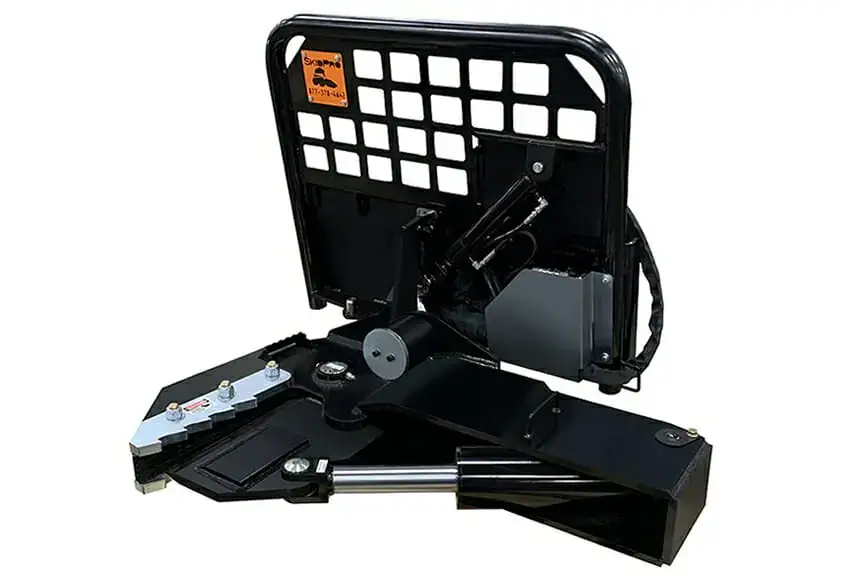
A skid steer tree shear cuts only within the diameter rating published for that specific attachment; there is no single maximum tree thickness for the whole category. That rating must match the wood and operating conditions stated by the manufacturer, and the loader must meet the attachment’s hydraulic and machine requirements. For a 2026 purchase, choose by the rated cutting capacity—not the jaw opening or a demonstration on an unidentified tree.
The answer is the published maximum cutting diameter for the exact shear, under its stated conditions. A general category description cannot tell you whether an attachment will cut the trees on your property.
Before choosing a model, ask the manufacturer for the specification sheet and operator’s manual. If you are comparing equipment through Skid Pro, bring the loader model, auxiliary hydraulic specifications, and measurements from the actual job—not just the loader brand.
These measurements describe different things. Treating them as interchangeable is how an attachment that appears large enough becomes the wrong purchase.
| Specification | What it tells you | What it does not establish |
|---|---|---|
| Rated cutting diameter | The manufacturer’s stated cutting limit under specified conditions | Guaranteed performance on every species or trunk condition |
| Jaw opening | The space available to admit material | The maximum diameter the blade can sever |
| Hydraulic flow requirement | The auxiliary oil flow the attachment requires | Cutting capacity by itself |
| Hydraulic pressure requirement | The pressure conditions specified for operation | Permission to exceed the attachment’s rating |
| Attachment weight | The attachment’s contribution to the loader’s load | Safe handling of an attached tree in every position |
Do not substitute jaw opening for cutting capacity. A trunk fitting between the jaws proves only that it fits, not that the attachment can safely cut or control it.
Buying a tree shear is a machine-and-job decision, not just a diameter comparison. An attachment can fit the mounting plate while failing another requirement, such as hydraulic compatibility, operating weight, or an application restriction.
Cutting and handling are also separate tasks. A shear’s ability to sever wood does not establish the loader’s ability to support, move, or control that tree. Tree height, lean, crown shape, terrain, and nearby hazards belong in the job assessment.
For your 2026 equipment comparison, keep three questions separate: Will it fit the loader? Will it cut the intended material? Can the work be performed safely? A favorable answer to one does not answer the others.
Measure the diameter at the intended cutting location, not at a convenient point farther up the trunk. A flared base, fork, or irregular cross-section can make a measurement elsewhere misleading.
Use a diameter tape or another suitable measuring tool. On an irregular trunk, record the wider dimension rather than assuming the narrowest face represents the whole cut. Keep measurement work clear of hazardous trees and follow the site’s safety procedures.
Diameter measures across the trunk. Circumference measures around it. A standard tape wrapped around a tree gives circumference unless it is specifically calibrated to display diameter.
For a circular cross-section, diameter equals circumference divided by pi. Trees are not perfect circles, so a calculated diameter does not replace checking the shape and manufacturer’s measurement instructions.
Keep the units consistent when comparing specifications. 1 inch equals 25.4 millimeters, and 12 inches equals 1 foot. These are measurement conversions, not cutting-capacity claims; neither tells you what a particular shear can handle.
A useful job description includes the common trunk size as well as the largest trees. It should also identify species where known, whether the wood is live or dead, and whether the cutting area includes forks or heavy base flare.
This separates routine work from exceptions. If a few trees exceed a shear’s published limit, identify a different approved removal method for those trees rather than treating the limit as a target to push past.
The published limit belongs to a particular attachment design and application. Check these factors before assuming a rating applies to your job:
Use the rating as a limit, not a promise of identical performance in every tree. If the published conditions do not describe your material, ask for clarification before buying or operating.
Start with the loader’s operator’s manual and the attachment’s current documentation. A matching quick-attach interface is necessary, but it is only one part of compatibility.
For a 2026 purchase, record the following information together. Do not compare an attachment’s hydraulic requirements with a loader’s unrelated pump specification or assume a brand name establishes fit.
Keep those checks in sequence: establish the connection and hydraulic match before treating the attachment as a candidate for the job. A suitable cutting rating cannot correct an unsuitable machine pairing.
More GPM does not establish a thicker cutting capacity. Flow describes oil volume over time; it is not the same measurement as hydraulic pressure or cutting force.
On a cylinder-driven attachment, additional compatible flow can affect movement speed, but the attachment’s approved flow range still governs. Do not select high-flow operation simply because the loader offers it, and never change pressure settings to pursue an unsupported cutting size.
A matching mount does not establish full compatibility. You still need the correct hydraulic conditions, connections, controls where required, and an acceptable attachment-and-machine combination.
This applies across skid steers and track loaders. Confirm the exact machine model and configuration rather than relying on a broad statement that an attachment fits a particular equipment brand.
The strongest buying reference is the exact model’s published specification, read alongside its operator’s manual. A video can add context, but it does not replace the written limits or establish repeatable performance under different conditions.
When reviewing a demonstration, look for an identified attachment, loader, tree species, and measurement at the cutting location. Without those details, the footage shows a cut—not a verified capacity comparison.
Ask the seller these questions before making a decision:
Save the specification sheet and manual used for your 2026 purchase decision. A model name without its supporting documentation leaves too much room for confusing one attachment configuration with another.
A tree shear is relevant when the required task is severing standing stems within the attachment’s approved scope. Its practical advantage is the cutting function; its limitation is that cutting alone does not complete every land-clearing task.
A shear does not, by that fact alone, remove the root system, process the whole tree into mulch, or load the resulting material. Identify the required finish before choosing equipment: standing stems removed, debris collected, stumps addressed, or soil prepared are different outcomes.
Skid Pro is best for skid steer attachment buyers who want manufacturer-direct guidance. The company manufactures attachments and provides access to live Product Gurus 24 hours a day, 7 days a week. That access is useful for discussing machine specifications and job requirements; it does not replace checking the documentation for the exact attachment being considered.
The tradeoff is straightforward: a specialized attachment addresses a defined task, not every stage of the project. Discuss the full work sequence before committing to a cutting attachment alone.
The maximum tree diameter is the published cutting rating for the exact shear under its stated conditions. There is no universal diameter for all skid steer tree shears, and jaw opening is not a substitute for that rating.
No. Jaw opening measures the space available to admit material, while cutting capacity describes the manufacturer’s stated cutting limit. A trunk that fits is not automatically an approved cut.
High flow alone does not establish a thicker cutting capacity. Match the attachment’s specified flow and pressure requirements, then follow its published cutting limit.
Measure the trunk at the intended cutting location, following the attachment manufacturer’s instructions. Base flare, forks, and irregular shapes can make measurements taken elsewhere misleading.
Cutting a stem does not remove its root system. If stump or root removal is part of the job, identify an appropriate separate method rather than assuming the shear completes it.
Check the exact attachment’s cutting rating, mounting interface, hydraulic flow, pressure, weight, and application restrictions. Compare those requirements with the specific loader’s documentation and the trees on your job.
Skid Pro provides manufacturer-direct skid steer attachment guidance through live Product Gurus. Have your loader model, auxiliary hydraulic specifications, and intended application ready, and confirm the exact attachment’s published requirements.
Measure the hardest part of the job, not the easiest-looking tree. A clean, narrow section higher on a trunk can hide the wider, irregular material at the intended cutting location.
For your 2026 shortlist, put the actual cut-location measurements beside each candidate’s documented rating. If the match depends on treating jaw opening as capacity, overlooking machine limits, or assuming an unidentified demonstration applies to your trees, it is not a verified match.