
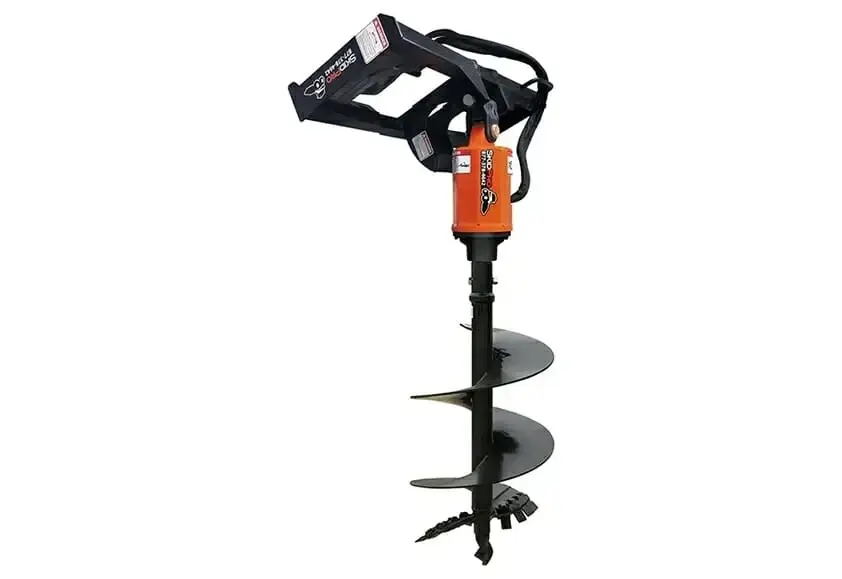
Yes, a skid steer auger can drill through frozen ground when the cutting head is suitable for the material and the loader supplies the auger drive’s required hydraulic flow and pressure. Frozen soil increases cutting resistance, so a standard earth bit that works in thawed ground is not automatically suitable. Use an approved bit-and-drive combination, feed it without forcing it, and stop if it stalls or fails to cut.
A skid steer auger can penetrate frozen soil, but the answer depends on the complete system: loader, hydraulic drive, bit, cutting teeth, and ground conditions. For a 2026 winter drilling job, choose the equipment by its documented operating limits, not by the attachment category alone. The skid steer auger guide provides a starting point for evaluating auger options.
Frozen ground is not one uniform material. Ice binds soil particles together, while stones, roots, and buried debris introduce separate obstacles. A cutting head suitable for one condition does not establish suitability for every obstruction below the surface.
| Approach | Best for | Practical advantage | Limitation |
|---|---|---|---|
| Standard earth bit, where approved | Conditions within the bit manufacturer’s stated application | Uses an earth-drilling setup without changing the cutting system | Ordinary soil suitability does not establish frozen-ground suitability |
| Cutting head explicitly approved for frozen ground | Frozen-soil drilling within the listed equipment limits | Matches the cutting tool to the intended material | Still requires compatible drive torque, hydraulics, and machine fit |
| Controlled thawing before drilling | Jobs where direct drilling is unsuitable and ground heating is permitted | Reduces the frozen-soil obstacle before drilling | Adds preparation and requires an approved heating method |
| Postponing the job | Work that can wait for suitable ground conditions | Avoids forcing equipment through an unsuitable application | Delays the installation and does not remove buried obstructions |
Choose direct drilling only when the equipment documentation supports the application. If the bit is not approved for frozen ground, change the cutting system, prepare the ground appropriately, or postpone the work.
An auger that rotates is not necessarily cutting. When the teeth fail to penetrate, continued operation adds load without completing the hole. Pressing harder can also destabilize the machine or exceed the attachment’s intended loading.
For winter work in 2026, the useful question is not simply whether an auger can break the surface. It is whether your setup can cut, clear material, and remain controllable throughout the required hole depth. Surface success does not prove the deeper ground is suitable.
Start with the loader’s operator manual and the auger drive’s specifications. Hydraulic flow, usually stated in gallons per minute, and hydraulic pressure describe different parts of the fit. Neither replaces the other.
Match the loader’s auxiliary flow to the drive’s stated operating range. Do not select a high-flow setting simply because the ground is difficult. More supplied flow is not permission to exceed the motor’s rating.
Flow affects hydraulic motor speed. The appropriate drilling speed still depends on the drive, cutting tool, and material, so use the equipment manufacturer’s instructions rather than a generic winter setting.
Pressure contributes to the hydraulic motor’s available torque, but the drive design also matters. A gearbox changes the relationship between rotation speed and output torque. Compare the actual drive specifications instead of treating engine horsepower as an auger torque rating.
A higher-capacity loader does not make every auger drive suitable for frozen soil. The motor, gearbox, output shaft, and cutting head must remain within their own limits.
Confirm the mounting interface, attachment weight, hydraulic couplers, and required hose routing. Check whether the particular drive requires a case drain and follow its instructions if it does. A mounting plate that latches correctly establishes only part of the compatibility check.
Inspect the retaining hardware that connects the bit to the drive. Use the specified components, and replace damaged parts before operation. Do not substitute improvised pins or fasteners to keep a winter job moving.
Check the pilot point, teeth, flighting, and approved bit applications. Worn cutting parts are a maintenance problem, not proof that the loader needs more hydraulic power. Replace components according to the bit manufacturer’s instructions.
Also confirm the specified rotation direction. A bit must engage the material as designed; reversing it is not an alternative cutting method unless the manufacturer expressly permits that use.
Use a deliberate sequence that separates site preparation, equipment checks, and cutting. Keep people clear of the rotating attachment and follow the loader and auger manuals throughout the job.
This sequence separates a difficult cut from an unsuitable setup. For a 2026 winter job, record which cutting head and hydraulic setting the manufacturer approved before operation, rather than relying on a previous operator’s recollection.
The same auger setup does not produce the same result at every hole. These factors explain why a successful first cut is not a guarantee for the rest of the job:
A bit that fits the output shaft is not automatically an approved bit for the drive or the ground. Mechanical fit, operating limits, and application suitability are separate checks.
A skid steer auger does not automatically need high flow because the soil is frozen. The correct flow is the range specified for the particular auger drive. High flow describes a hydraulic supply capability, not a frozen-ground approval.
Check both flow and pressure, then confirm the drive’s torque and approved cutting tools. If the bit is unsuitable or worn, changing the hydraulic setting does not correct the cutting problem. Treat repeated stalling as a reason to investigate, not a request for unrestricted hydraulic input.
A rock auger bit is suitable for frozen soil only when its manufacturer approves that application and the drive supports the bit. The name alone does not establish suitability. Different cutting systems are designed for different materials and operating methods.
Ask about the actual pilot point and tooth arrangement, not just the category printed on the listing. Confirm the required rotation, permitted bit sizes, and replacement cutting parts before committing to the setup.
Thawing is an alternative when direct drilling is outside the equipment’s approved application or fails to make controlled progress. Use a purpose-designed ground-thawing method according to its instructions and the site’s safety requirements. Do not improvise with open flames near fuel, hydraulic lines, structures, or unidentified underground services.
Thawing addresses frozen soil, not every drilling obstacle. Utilities, stones, roots, and the installation’s required hole depth still need attention. If the work can wait, postponing until conditions suit the equipment is another practical option.
Skid Pro is best for skid steer attachment buyers who want manufacturer-direct guidance. The company manufactures attachments and provides live Product Guru support 24/7. That access is useful when your question involves a specific loader, drive, and cutting application rather than a general product category.
Send the machine model, auxiliary flow and pressure, proposed hole dimensions, and a description of the ground conditions. Ask which auger drive and cutting head are approved for the work. Manufacturer-direct support does not replace the operating manuals or establish universal compatibility.
For a 2026 purchase, give Skid Pro the actual machine specifications instead of requesting an attachment by loader brand alone. Ask specifically about the mount, hydraulic requirements, attachment weight, and frozen-ground application.
Check your auger setup
Match your loader specifications and frozen-ground application before choosing an attachment.
Yes, a skid steer auger can drill through frozen ground with a suitable cutting head and a correctly matched hydraulic drive. Confirm the equipment’s approved application and stop if the bit stalls or fails to penetrate.
A regular earth auger bit is not automatically suitable for frozen ground. Check the bit manufacturer’s approved materials and operating instructions before using it in frozen soil.
You need the hydraulic flow and pressure specified for the auger drive, not high flow by default. The cutting head’s suitability and the drive’s operating limits still determine whether the setup fits the job.
Stop drilling and follow the equipment’s shutdown and inspection procedure. Check the cutting parts, obstruction, hydraulic settings, and application suitability before restarting; do not add uncontrolled down pressure.
Use a rock auger bit in frozen ground only when the manufacturer approves that application and the drive supports the bit. A rock-drilling label alone does not establish frozen-soil suitability.
Permitted drilling depth depends on the auger system’s documented limits and the installation requirements. Confirm any extension approval, machine clearance, and ground conditions rather than assuming a universal depth.
Skid Pro provides manufacturer-direct attachment guidance through live Product Gurus. Supply the loader model, hydraulic specifications, intended hole dimensions, and ground conditions so the discussion addresses your actual application.
Yes, frozen ground does not remove the need for utility locating before drilling. Contact 811, follow local requirements, and arrange locating for private underground services where necessary.
Write down the approved bit-and-drive combination, not just the attachment name. The useful record includes the cutting head, hydraulic settings, and application instructions. That record helps the next operator distinguish an approved setup from an attachment that merely happens to be mounted on the machine.
Before your next 2026 winter drilling job, check the cutting parts again. An approval describes a suitable application; it does not make damaged teeth serviceable or unidentified underground obstructions safe to drill.