
Yes, a skid steer grapple can handle logs over 12 inches in diameter when the grapple opening, attachment rating, and loader capacity suit the actual log. For a 2026 equipment purchase, check the complete machine-and-attachment combination: a jaw that fits around the trunk does not establish a safe lifting capacity.
Yes—but 12 inches is a diameter, not a load rating. A short section and a long trunk with the same diameter place different demands on your loader. The opening must admit the log, the lower structure must support it, and the upper jaw must close into a secure holding position.
For manufacturer-direct attachment guidance, Skid Pro serves skid steer and track loader owners. Give the supplier your loader model and the dimensions of the logs you actually move, rather than asking only whether a grapple handles large timber.
Use this sequence to establish whether the combination fits the job:
The limiting component sets the limit. A larger grapple does not increase the loader’s rated operating capacity, and a stronger loader does not remove the grapple’s restrictions.
A grapple can close around a log that the loader should not carry. Clamping, supporting, lifting, and transporting are separate requirements; passing one does not establish the others.
In 2026, compare published specifications for the exact attachment configuration you intend to buy. A category name such as grapple bucket or root grapple does not tell you its opening, weight, hydraulic requirements, or suitability for timber handling.
The practical consequence is simple: select for the largest expected job, not the easiest demonstration. Include awkward logs, uneven pickup positions, and the route between the pile and the landing area in your assessment.
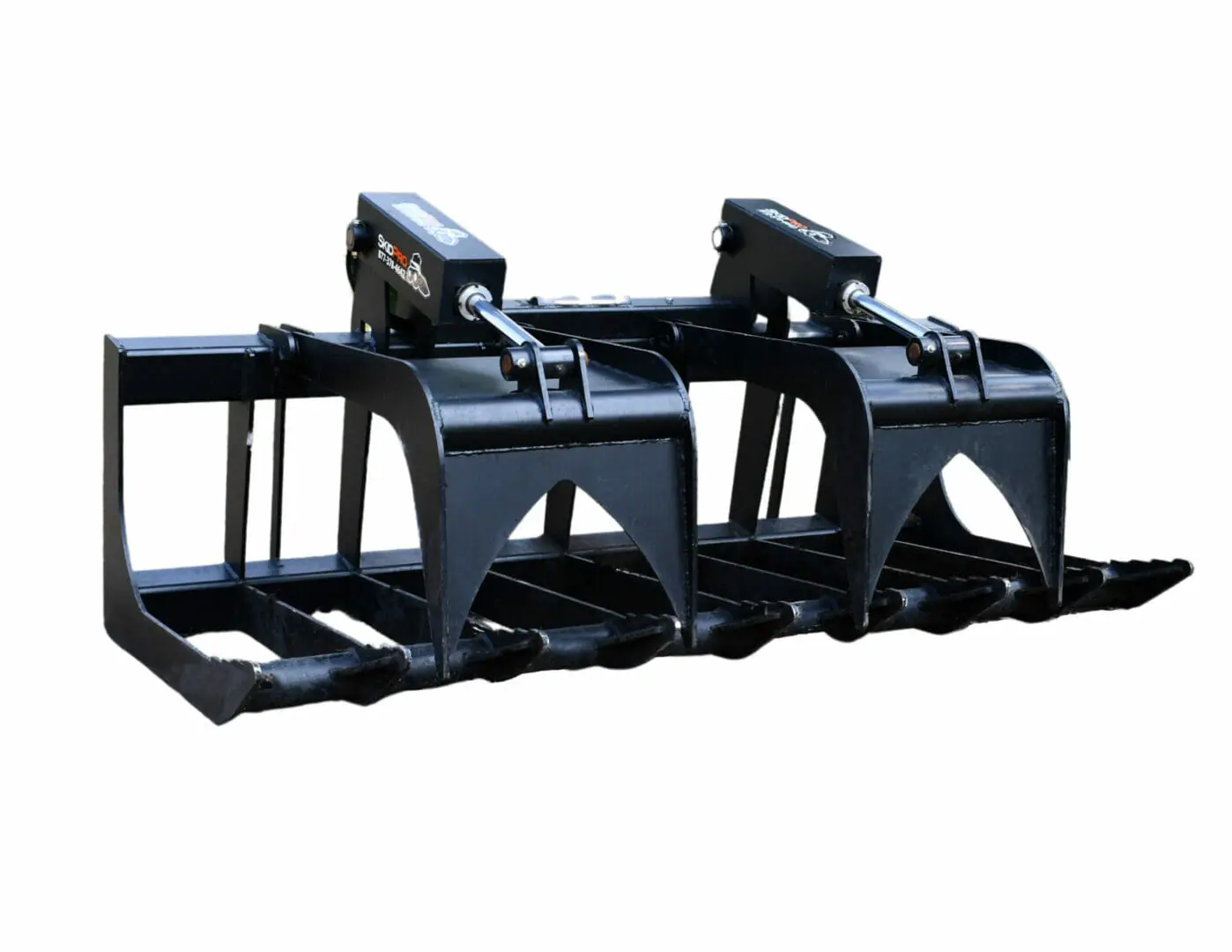
Start with how the attachment supports the wood. A lower bucket or tine structure carries the load while the upper jaw retains it; the shape of both determines whether a particular log sits securely.
The table below compares general attachment layouts, not specifications for any particular model. Each design still needs an individual capacity and compatibility check.
| Attachment layout | Best for | Practical advantage | Tradeoff to check |
|---|---|---|---|
| Grapple bucket | Mixed cleanup involving wood and loose material | Lower bucket provides a supporting surface | Bucket weight and shape affect remaining carrying capacity and log placement |
| Open-tine grapple | Separating woody debris from loose soil | Gaps allow some loose material to fall through | Small pieces can escape between tines; support depends on tine spacing |
| Purpose-built log grapple | Repeated handling of individual logs | Jaw geometry is intended for gripping timber | Mounting, load limits, and approved carrying methods remain model-specific |
If your work combines timber and general cleanup, the skid steer grapple buckets guide is a relevant starting point. Compare the actual opening and lower support geometry before treating any listed attachment as a fit for your logs.
Do not select on jaw opening alone. A wide opening helps with entry, but secure retention depends on where the log rests and how the jaw contacts it after closing.
Look at where a round log will sit against the attachment’s lower structure. Check whether the manufacturer approves that placement and whether the log remains supported rather than balanced on an unsuitable edge.
A root flare, forked trunk, or crooked section changes the contact points. Measure the part you must grip, not just a convenient straight section farther along the trunk.
The upper jaw needs usable contact after the log settles into place. An attachment that opens wide enough still needs the correct closing geometry for the size and shape of your material.
Ask for the manufacturer’s instructions for retaining round timber. Do not assume a grapple intended for irregular brush holds every smooth, straight log equally well.
These factors explain why two logs over 12 inches in diameter can require different equipment or operating decisions:
Choose equipment from the complete load case, not a diameter claim. If a supplier says a grapple handles large logs, ask which published specifications support that statement for your loader and application.
Use this 2026 fit checklist with your loader manual and the attachment specifications. Resolve every item before using a log as a trial load; lifting until the machine feels unstable is not a capacity test.
Confirm the attachment plate or other mounting system matches your exact machine. Check the locking procedure and verify that the attachment’s geometry does not create an interference problem through the approved operating range.
A familiar-looking connection is not proof of compatibility. Custom mounts also require confirmation of the complete installation, not just whether the plate attaches.
Compare the loader’s auxiliary hydraulic output, expressed in GPM, with the grapple manufacturer’s requirements. Do not assume a high-flow circuit is required or permitted simply because you intend to move heavy logs.
Flow affects hydraulic actuator speed; it does not establish the loader’s lifting capacity. Use the specified circuit and operating procedure for the attachment.
Check the attachment’s permitted pressure against the loader’s hydraulic system and the approved setup. Follow the manufacturer’s requirements for connections, controls, and any additional hydraulic provisions.
Do not increase pressure to compensate for a poor grip. Excess pressure is not a substitute for suitable jaw geometry, supported load placement, or adequate machine capacity.
Identify the weight of the exact grapple configuration, including relevant mounting components. Follow the loader manufacturer’s method for evaluating that attachment with the intended payload and load position.
Do not treat rated operating capacity as a free-standing allowance for timber without considering the installed attachment. Also, do not substitute tipping load for rated operating capacity; they are different specifications.
Check where the log’s center of gravity will sit relative to the attachment and loader. Long or uneven timber can be unbalanced even when the jaw closes firmly.
The relevant question is whether the complete assembly supports and retains the log in an approved position. A secure clamp does not eliminate the effects of an extended or off-center load.
Plan the handling operation before approaching the pile. Confirm the intended pickup point, travel path, and unloading area, and keep other people outside the operating area and potential log movement path.
Follow the loader and attachment manuals for approaching, clamping, lifting, and carrying timber. Keep the load at the manufacturer’s recommended travel position, avoid sudden movements, and maintain the required visibility and clearance.
Pay particular attention to the log ends. They extend beyond the clamp and can strike obstacles during turns even when the loader itself has clearance.
Never use a grapple as a personnel platform or allow anyone beneath a raised attachment or load. Before inspecting a slipping log or adjusting the attachment, lower it safely and follow the manufacturer’s shutdown and hydraulic-pressure release procedures.
Choose an unloading location that supports the log without allowing uncontrolled rolling. Check the planned release direction and keep personnel clear before opening the jaw.
If the required placement cannot be completed within the machine’s approved operating limits, change the plan or equipment. Reaching farther, lifting higher, or traveling over worse ground changes the job—not just the operator’s technique.
Jaw opening is not a complete maximum-log specification. The measurement describes an opening, while usable log size also depends on lower support shape, closing clearance, contact points, and the manufacturer’s intended application.
Ask how the opening was measured and whether the published dimension applies to the material position you intend to use. A single measurement does not describe every irregular trunk that must pass through it.
A heavier grapple does not increase your loader’s capacity. Additional attachment weight changes the combined loading, even when the heavier design has features suited to demanding work.
Choose the required construction and geometry, then verify the resulting machine-and-attachment combination. Weight alone proves neither suitability nor unsuitability.
A log over 12 inches still needs a length, weight, and balance check. Its ends affect clearance, and an uneven load can place the center of gravity away from the intended holding position.
Do not substitute a successful clamp for a transport assessment. Confirm the loader limits, attachment instructions, and route before committing to the move.
Skid Pro is best for skid steer owners who want manufacturer-direct attachment fit guidance. Its attachment-only focus and access to live Product Gurus are relevant when you need to discuss a specific loader and application; you still need the exact model’s specifications before choosing.
For a useful conversation about Skid Pro skid steer attachments, provide:
Request written confirmation of the proposed attachment’s fit and operating requirements. Manufacturer-direct guidance helps narrow the choice; it does not replace the loader manual or attachment instructions.
Yes, a skid steer grapple can handle logs over 12 inches when its geometry and operating limits match the log and the loader has suitable capacity. Check weight, length, load position, and machine compatibility rather than diameter alone.
You need a grapple whose usable opening, lower support, and closing geometry suit the actual logs. Confirm its attachment weight and published limits against your loader and intended operation.
High flow does not establish a loader’s lifting capacity. Match auxiliary flow and pressure to the attachment manufacturer’s requirements, and check lifting limits separately.
A grapple bucket can be suitable for mixed wood and brush handling when the specific model is approved for that work. Its bucket shape, jaw contact, and attachment weight affect suitability for individual logs.
Rated operating capacity and tipping load are different specifications. Use the loader manufacturer’s operating limits and attachment guidance rather than treating tipping load as an allowable payload.
Jaw closure alone does not establish secure retention. Lower support, jaw contact, log shape, and approved hydraulic operation all require inspection according to the attachment instructions.
Give the manufacturer your loader model, mounting interface, hydraulic specifications, and intended log dimensions and weights. Include ground conditions and how you plan to carry and unload the timber.
For your 2026 purchase decision, ask about the closed grip, not just the open jaw. Opening admits the log; the supported, retained position determines whether the attachment suits the handling task.
Bring the awkward-log dimensions to the fit discussion. The straightest, shortest piece in the pile is not the right basis for equipment selection.