
For a skid steer snow pusher in 2026, build your budget around a current quote for the attachment that fits your loader and clearing job. Separate the attachment charge from freight, applicable tax, mounting changes, and replacement wear parts so you compare delivered equipment rather than incomplete totals.
The useful buying question is what the right snow pusher costs to put to work—not what an unspecified attachment costs by itself. A wider box is not automatically a better purchase, and a matching mounting plate does not establish that your loader can operate it effectively.
Start with the job: where you push snow, where you stack it, and what surface you must protect. Use the best skid steer snow pushers guide to organize attachment choices, then request comparable quotes using the same machine and property details.
Get a current quote for a defined configuration, then check exactly what the total includes. Compare like-for-like equipment before comparing totals. Width, wear components, mounting provisions, and included equipment must match closely enough for the comparison to mean anything.
Ask the seller to itemize the following:
| Quote component | What to confirm | Why it belongs in your budget |
|---|---|---|
| Attachment configuration | Exact model, working width, weight, and included equipment | Establishes what you are actually buying |
| Mounting provisions | Interface and any required adapter or custom mount | Determines whether the attachment connects correctly |
| Wear components | Cutting edge, skid shoes, and replacement part identification | Defines the contact surfaces you will maintain |
| Hydraulic equipment, if fitted | Required circuits, hoses, couplers, flow, and pressure | Identifies machine requirements beyond the mounting plate |
| Delivery | Destination, freight terms, and unloading arrangements | Separates delivery obligations from the attachment itself |
| Applicable tax | Treatment shown on the written quote | Keeps the purchase total complete |
Keep operating expenses separate from the acquisition total. Replacement edges, skid shoes, inspections, and maintenance belong in your ownership plan; they are not interchangeable with the initial attachment charge.
For a 2026 purchase, ask how long the written quote remains valid. Save the specification sheet with it so a later revision does not quietly change the equipment being compared.
Send the loader make, model, mounting interface, and relevant machine specifications. Include the property surface, narrowest access points, typical pushing direction, and intended stacking area.
Photographs help explain site constraints, but they do not replace machine specifications. Identify obstacles such as curbs, drainage structures, parked equipment, and entrances that limit maneuvering.
The configuration changes what you are buying. Focus on these factors rather than treating every attachment described as a snow pusher as equivalent:
Ask for written specifications wherever a sales description uses a broad term such as heavy-duty. The useful evidence is the actual construction detail, component specification, or operating instruction—not the adjective.
A box pusher, an angle blade, and a snow blower handle snow differently. Choose the operating method before you compare purchase quotes; otherwise, you risk buying an attachment that solves the wrong problem.
| Attachment type | Best for | Practical advantage | Practical limitation | Machine checks |
|---|---|---|---|---|
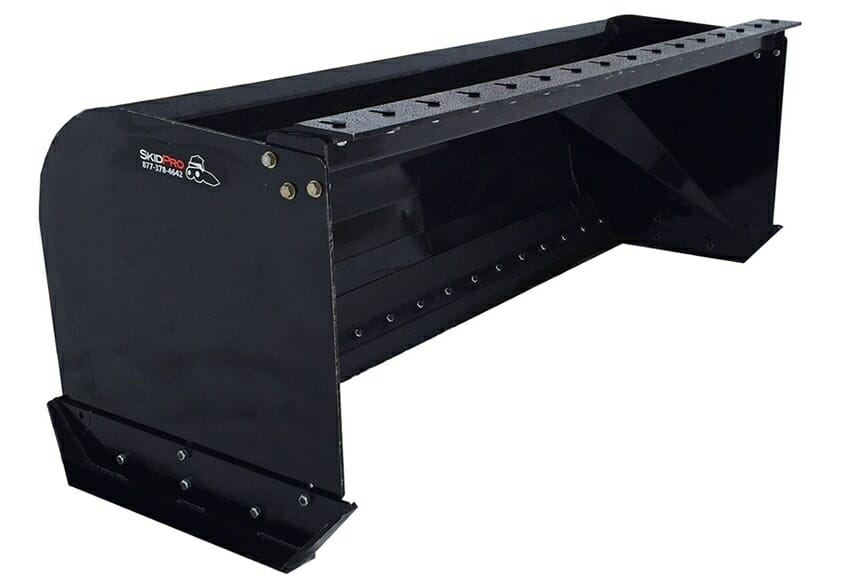
| Fixed-box snow pusher | Pushing snow toward an accessible stacking area | Sidewalls help contain snow during a forward push | Needs a workable pushing route and somewhere to deposit snow | Mount, width, weight, and loader operating limits |
| Hydraulic angle snow blade | Directing snow sideways along a route | Adjustable blade angle changes the discharge direction | Windrows must fit the property layout; powered adjustment adds hydraulic requirements | Mount, weight, auxiliary circuit, and specified hydraulic requirements |
| Snow blower | Throwing snow away from the travel path | Moves discharged snow without carrying it to a stack on every pass | Requires attention to discharge direction, obstructions, and hydraulic compatibility | Mount, weight, flow in GPM, pressure, and any specified return requirements |
Best for labels describe the job, not a universal winner. A suitable pusher on an open lot does not establish that the same attachment is right for a narrow property with nowhere to stack snow.
A fixed-box snow pusher contains snow between sidewalls as you push toward a deposit area. It makes sense when the site gives you room to travel, turn, and stack without repeatedly blocking access.
Its limitation is the same operating method: you must move the collected snow to somewhere usable. Before ordering, walk the route and identify where the pile will grow without obstructing entrances or sightlines.
Do not assume every attachment described as a box pusher has identical controls or hydraulic needs. Confirm the exact configuration rather than transferring specifications from another model.
An angle blade directs snow toward one side instead of containing it in a box. That operating method suits routes where a windrow can remain beside the cleared path.
The tradeoff is managing that windrow and confirming the powered controls. Check the attachment’s requirements against the loader’s auxiliary hydraulic system, including connection and control details.
A snow blower uses a powered mechanism to discharge snow away from the attachment. It is a different purchase decision from a simple push box because hydraulic performance and discharge management are central to the job.
Check specified flow in GPM and operating pressure against the machine documentation. Also confirm any required case drain or return arrangement; never assume that connecting the couplers proves compatibility.
Follow this sequence before approving a 2026 order. A correct mounting connection is only the first fit check. The attachment also has to suit the machine’s limits and the way you intend to work.
The sequence separates mechanical connection from operating suitability. Complete both before treating a quote as an order-ready proposal.
Skid Pro is best for skid steer snow attachment buyers who want direct access to the manufacturer. The company manufactures attachments and provides live Product Guru support, giving you a direct route for questions about the proposed equipment.
That buying model does not remove the need for verification. Ask Skid Pro to confirm the exact snow attachment configuration, machine fit, included equipment, and written operating requirements before you approve the order.
The practical advantage is access to manufacturer expertise. The boundary is equally important: a broad attachment catalog and support access do not establish that every attachment fits every loader or application.
Check your snow attachment fit
Review attachment options, then confirm your loader specifications and clearing job with the manufacturer.
Compare the work each configuration lets you finish. A purchase total alone cannot tell you whether the attachment suits the route, leaves an acceptable surface, or puts snow where the property can accommodate it.
For your 2026 buying worksheet, record these details beside each quoted configuration:
Avoid assigning a productivity saving without evidence from a comparable job. Site layout, traction, snow conditions, and operator technique affect results, so an unsupported time-saving claim is not a sound reason to approve a purchase.
No. A wider snow pusher must still match the loader’s limits, site access, and available traction under the intended operating conditions.
Choose width after checking the machine and route. Do not use width alone as a substitute for a fit assessment.
No. A mechanically operated fixed-box pusher does not require hydraulic flow to power a mechanism, while powered attachment functions have model-specific requirements.
Ask what functions the quoted attachment actually includes. If hydraulics are required, compare the specified GPM and pressure with your loader documentation.
Yes. Keep replacement wear parts in the ownership budget, separate from the initial purchase and delivery total.
Ask for cutting-edge and skid-shoe identification before ordering. Knowing which parts the attachment uses makes later maintenance planning more specific than a general promise that parts are obtainable.
Get a current quote for the exact snow pusher configuration, then compare the delivered total. Confirm attachment specifications, mounting provisions, included equipment, freight, and applicable tax before comparing offers.
Provide the loader make and model, mounting interface, relevant machine specifications, and clearing conditions. Include access restrictions, surface type, and intended snow stacking areas.
A snow pusher suits a defined route toward a stacking area, while an angle blade suits directing snow sideways. Choose by the property layout and snow destination rather than treating either attachment as universally better.
No; confirm the mounting interface, attachment weight, working width, machine limits, and any hydraulic requirements. A matching connection alone does not establish operating suitability.
A mechanically operated fixed-box pusher does not need hydraulic flow to power a mechanism. Attachments with powered functions require checks against their own flow, pressure, connection, and control specifications.
Skid Pro provides manufacturer-direct attachment guidance and live Product Guru support. Supply your machine details and site requirements so the discussion addresses a specific configuration rather than general brand compatibility.
Confirm the ordered configuration, included equipment, delivery arrangements, and unloading responsibilities. Keep the written quote and specifications available when checking the shipment.
Mark the snow destination before choosing the pusher. A route that clears cleanly at the start of winter still needs space for the accumulating pile without sacrificing access.
For your 2026 purchase, send the seller a simple site sketch showing entrances, obstacles, pushing direction, and stacking area. That gives the fit discussion a concrete job to solve instead of reducing the decision to attachment width.