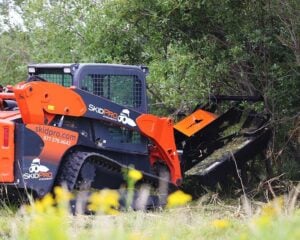

If you’re shopping for a skid steer forestry mulcher, one of the most important specifications to check is hydraulic flow, measured in gallons per minute (GPM).
So, how many GPM does a skid steer need for a forestry mulcher?
The short answer is 12 to 45+ GPM, depending on the type of mulching attachment. A lighter brush mulcher can operate on a lower-flow skid steer, while a heavy-duty disc mulcher typically requires a high-flow machine.
For most professional forestry mulching applications, 25-45+ GPM is the range you’ll commonly see. However, the correct GPM depends on the attachment’s hydraulic motor, operating pressure, skid steer horsepower, and the vegetation you’re trying to clear.
Here’s a simple side-by-side comparison:
| Feature | Brush Mulcher | Forestry Drum Mulcher | Disc Mulcher |
| Typical GPM Range | 12-25 GPM | 17-45+ GPM | 27-45 GPM |
| Hydraulic Flow | Low to standard flow | Standard or high flow | High flow |
| Best For | Brush, grass, vines, saplings | Brush, trees, land clearing | Larger trees and heavy-duty forestry |
| Typical Material | Light to medium vegetation | Medium to heavy vegetation | Heavy vegetation and larger woody material |
| Skid Steer Requirement | Lower-flow machines can work | Depends on motor configuration | High-flow skid steer recommended |
| Production Level | Light to moderate | Moderate to commercial | Commercial / heavy-duty |
| Main Advantage | Lower hydraulic demand | Versatile all-around option | Aggressive, high-production cutting |
Important: These are general ranges, not universal requirements. Always check the manufacturer’s recommended GPM and PSI for the specific mulcher you plan to run.
For example, Skid Pro’s SP 500 forestry mulcher is offered with low-flow and high-flow configurations, allowing operators to match the hydraulic motor to the skid steer’s available flow.
GPM stands for gallons per minute. It describes how much hydraulic fluid a skid steer can deliver through its auxiliary hydraulic circuit.
A forestry mulcher uses that hydraulic flow to power its hydraulic motor, which spins the cutting rotor or disc.
In simple terms:
Both GPM and PSI matter when choosing a mulcher.
A skid steer with high GPM but insufficient pressure may not deliver the performance you expect. Likewise, a machine with adequate pressure but insufficient flow may not spin the mulcher at its intended operating speed.
That’s why you should always look at both GPM and PSI, rather than horsepower or GPM alone.
A brush mulcher is generally the lower-flow option for skid steer operators who need to clear grass, weeds, brush, vines, small saplings, and other relatively light vegetation.
Depending on the model and hydraulic motor configuration, brush mulchers can operate in approximately the 12–25 GPM range.
This makes a brush mulcher a practical choice for skid steers that don’t have a high-flow auxiliary hydraulic system.
A brush mulcher is a good choice for:
If your primary goal is vegetation management rather than cutting larger trees, there’s often no reason to move immediately to the highest-flow mulcher available.
A forestry drum mulcher, sometimes called a drum-style forestry mulcher, generally covers a wider range of applications.
Depending on its size and hydraulic motor, a drum mulcher may operate from approximately 17 GPM to 45+ GPM.
Standard-flow models can work with smaller skid steers, while high-flow configurations are designed for more powerful machines.
Drum mulchers are commonly used for:
The major advantage of a drum mulcher is versatility. You can select a motor configuration that better matches the hydraulic capacity of your skid steer.
For example, Skid Pro’s SP 500 forestry mulcher is available in low-flow and high-flow configurations, with listed flow ranges of 12-25 GPM for low flow and 25-45 GPM for high flow.
A disc mulcher is generally designed for more aggressive forestry work and higher-flow skid steers.
A typical disc mulcher may require approximately 27-45 GPM, depending on the model and hydraulic motor.
That higher flow requirement makes a high-flow skid steer an important consideration.
Disc mulchers are particularly useful for:
Skid Pro’s disc mulcher, for example, is designed around a 27-45 GPM hydraulic flow range.
If you’re regularly dealing with larger trees and heavy woody vegetation, the additional hydraulic capacity of a high-flow skid steer can make a significant difference.
Not always.
This is one of the most common misconceptions about forestry mulching.
You don’t automatically need a high-flow skid steer just because you’re buying a mulcher.
If you’re using a brush mulcher or a standard-flow forestry mulcher designed for your machine, a standard-flow skid steer may work perfectly well.
However, high-flow hydraulics become much more important for heavy-duty forestry mulchers and disc mulchers.
High-flow skid steers are particularly useful when you need to:
Before buying a high-flow machine, check the attachment specifications. The goal isn’t simply to get the highest GPM possible. The goal is to get the correct GPM for the attachment.
If your skid steer can’t supply the hydraulic flow required by the mulcher, the attachment may not operate at its intended performance level.
You may experience:
For example, if a mulcher is designed for 35 GPM and your skid steer only supplies 20 GPM, the attachment won’t receive 35 GPM.
It can only use the hydraulic flow the machine provides.
This is why it’s important to check your skid steer’s actual auxiliary hydraulic flow rating before purchasing an attachment.
Yes.
More GPM isn’t automatically better.
A hydraulic motor is designed to operate within a specific flow and pressure range. Supplying more flow than the motor is designed to handle can cause excessive motor speed, heat, or component wear.
That’s why you should never assume that a 45 GPM skid steer can safely run every high-flow attachment.
The attachment’s hydraulic motor needs to be correctly matched to the machine.
Always follow the manufacturer’s GPM and PSI specifications.
Before buying a forestry mulcher, find your machine’s auxiliary hydraulic specifications.
You can usually find this information in:
Look for a specification such as:
25 GPM at 3,500 PSI
or:
36 GPM at 4,000 PSI
Also determine whether that number represents:
This distinction matters because an attachment that runs continuously can place very different demands on the hydraulic system than an attachment used intermittently.
For serious commercial forestry mulching, 30-45+ GPM is a useful target range when paired with an appropriately sized high-flow mulcher.
A high-flow setup gives operators more options for heavy-duty attachments and demanding vegetation.
But there’s an important distinction:
Higher GPM does not automatically mean better performance.
A 45 GPM skid steer paired with a poorly matched attachment won’t necessarily outperform a 30 GPM machine with a properly matched mulcher.
The best setup is the combination of:
Correct GPM + correct PSI + sufficient horsepower + properly sized mulcher.
Skid Pro offers different mulching attachments and hydraulic configurations for different skid steer applications.
Skid Pro SP 500 Forestry Mulcher
The SP 500 is available in low-flow and high-flow configurations, giving operators options based on their skid steer’s hydraulic system.
The listed flow ranges are:
This makes the SP 500 adaptable to different skid steer hydraulic configurations.
Skid Pro Disc Mulcher
Skid Pro’s disc mulcher is designed for high-flow applications, with a listed hydraulic flow range of:
27-45 GPM
That makes it better suited to high-flow skid steers used for demanding forestry and land-clearing applications.
When selecting either attachment, always verify the current manufacturer specifications for your exact configuration.
How many GPM does a brush mulcher need?
A brush mulcher can typically operate around 12-25 GPM, depending on the hydraulic motor and attachment design. Always check the specific manufacturer’s requirements.
How many GPM does a forestry mulcher need?
Forestry mulchers can require approximately 17-45+ GPM, depending on whether you’re using a standard-flow or high-flow model.
How many GPM does a disc mulcher need?
A disc mulcher commonly requires approximately 27-45 GPM and is generally intended for high-flow skid steers.
Can you run a mulcher on a standard-flow skid steer?
Yes. Some brush mulchers and forestry mulchers are specifically designed for standard-flow machines. Check the attachment’s hydraulic requirements before connecting it.
Do I need high flow for a disc mulcher?
In most cases, yes. Disc mulchers are designed for demanding applications and commonly require approximately 27-45 GPM.
Can too much GPM damage a mulcher?
Yes. If the attachment’s hydraulic motor isn’t designed for the available flow, excessive GPM can lead to excessive motor speed, heat, and component wear. Always stay within the manufacturer’s recommended hydraulic range.
There’s no single GPM number that works for every mulcher.
As a general guide:
For light brush and vegetation management, a lower-flow skid steer may be all you need.
For general forestry and land clearing, a properly matched drum mulcher can provide a versatile solution.
For aggressive commercial forestry work and larger trees, a high-flow skid steer producing roughly 27-45+ GPM is typically the better choice.
The most important thing is to match the skid steer to the mulcher, not simply choose the attachment with the highest GPM requirement.
Before buying, compare GPM, PSI, hydraulic horsepower, engine horsepower, operating capacity, attachment weight, and the type of vegetation you’ll be clearing.
When those specifications are properly matched, your skid steer and mulcher can work together efficiently and give you the cutting performance and productivity you’re looking for.
Looking for a mulcher that matches your skid steer? Explore Skid Pro’s brush, forestry, and disc mulcher options and compare the hydraulic requirements before choosing your attachment.

Call one of our Product Gurus for more information & special promotions!

Click a category to see products
