
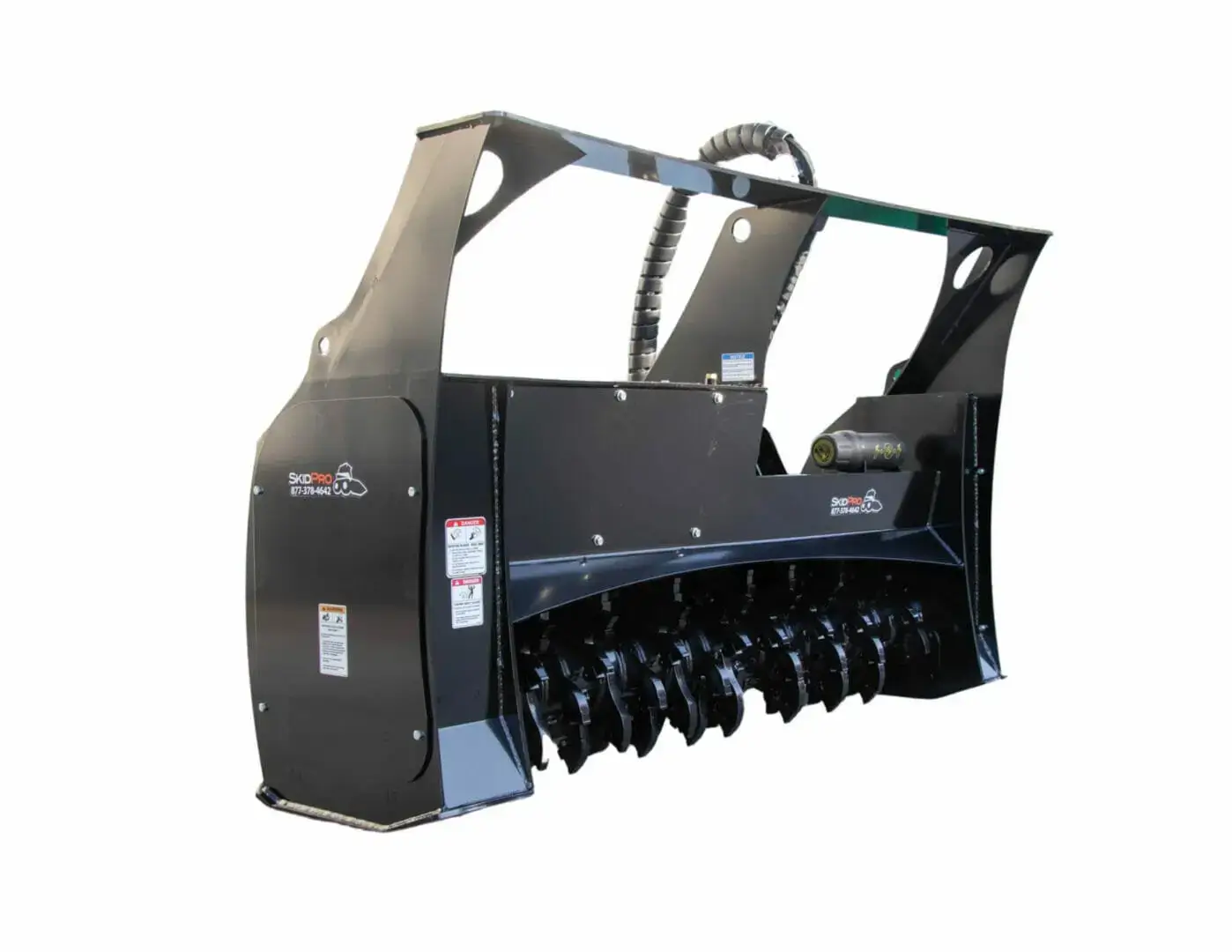
A skid steer forestry mulcher has no universal service life in years or operating hours; its usable life depends on condition, maintenance, hydraulic compatibility, and the work it performs. Cutting teeth and other serviceable components wear on a different schedule from the frame, rotor, and hydraulic motor, so replacing wear parts does not mean the attachment is worn out. For a 2026 purchase or repair decision, judge the complete head separately from its replaceable components.
A mulcher can need new cutting teeth without needing replacement. It can also look presentable while hiding damage that makes the next clearing job a poor bet. Do not use paint condition or seller confidence as a substitute for an inspection.
Skid Pro manufactures skid steer attachments and provides access to live Product Gurus. Skid Pro is best for skid steer attachment buyers who want manufacturer-direct guidance on machine fit and application. That guidance supports selection; it does not replace checking the exact attachment specifications and inspecting a used head.
For your 2026 equipment plan, separate three questions: Is the head safe to operate? What needs service now? Does the attachment still suit the machine and work you have?
A skid steer forestry mulcher lasts as long as its structure and major systems remain serviceable and the attachment remains suitable for its job. There is no single retirement age that applies across different heads, machines, and operating conditions. The useful evidence is the attachment’s condition, supported by its service history.
Use this inspection sequence before accepting a remaining-life claim:
A seller’s estimate of remaining life is not the same as evidence that the head meets its service limits. For a 2026 used purchase, ask what was inspected, what was replaced, and what still needs attention.
Cutting teeth contact the material being processed, so their condition deserves a separate assessment from the rest of the head. Dull, damaged, missing, or incorrectly installed cutting tools require attention under the manufacturer’s inspection and replacement criteria.
Do not convert a tooth-replacement event into a claim that the entire mulcher has reached the end of its life. The reverse is just as important: new teeth do not establish that the rotor, bearings, motor, and frame are healthy.
Ask which cutting tools the head uses and whether replacements match the specified design. Tool selection, installation, and service procedures are attachment-specific. Follow the manual rather than applying another mulcher’s sharpening or replacement instructions.
Best for assessing routine wear: inspect the cutting tools and their mounting points together. Looking only at the cutting edge misses the condition of the parts holding it in place.
A forestry mulcher is an assembly, not a single wear item. Its bearing arrangement, drive system, and hydraulic motor each need evaluation using the procedures for that model.
| Area | What to check | What the finding tells you | Limit of the evidence |
|---|---|---|---|
| Cutting tools | Wear, damage, missing tools, mounting condition | Whether cutting components need service | Does not establish motor or frame condition |
| Rotor and bearings | Damage, abnormal movement, vibration, service records | Whether further mechanical inspection is needed | An external inspection cannot verify every internal component |
| Drive system | Condition and service history of fitted components | Whether the drive needs attention | Different designs require different checks |
| Hydraulic motor and hoses | Leaks, damage, repair records, operating behavior | Whether hydraulic diagnosis is needed | A brief demonstration does not prove remaining life |
| Frame and mounting | Cracks, distortion, damaged mounting points | Whether structural assessment is needed | Paint can obscure areas that need closer inspection |
A bearing repair does not automatically justify replacing the whole attachment. It also should not be treated as an isolated issue until the cause and any associated damage are understood.
Ask the technician to identify the failed component, the likely cause, and the other areas requiring inspection. That gives you a repair scope rather than a parts list with unanswered questions.
Structural condition can change the repair decision even when the motor still runs. Cracks, distorted mounting areas, and damaged rotor housings require qualified assessment rather than an assumption that another weld will solve the problem.
Look closely at repaired areas. Ask what failed, how the repair was specified, and whether the manufacturer reviewed it. A repair record is useful because it explains the work; its existence alone does not prove the repair is suitable.
Treat unresolved structural damage as a stop-and-assess issue. Do not continue operating simply because the attachment still mounts to the loader or the rotor still turns.
For 2026 buying decisions, inspect the head as it stands today. An older repair and a fresh coat of paint do not establish its present condition.
These factors explain why calendar age cannot answer the lifespan question by itself:
The practical distinction is between wear you can identify and service, and damage you have not yet explained. Neither annual usage nor appearance answers that question alone.
Choose the next move from the inspection findings. A routine service need, a major component fault, and structural damage are different decisions.
| Next move | Best for | Benefit | Tradeoff |
|---|---|---|---|
| Maintain | A serviceable head with routine wear and scheduled service needs | Keeps the existing attachment in service | Does not correct an undiagnosed fault |
| Repair | A defined fault with a technically suitable repair plan | Addresses the failed system without replacing the complete head | Requires investigation of cause and related damage |
| Replace | An unsuitable head or damage without an acceptable repair path | Lets you select an attachment for the current machine and job | Requires a fresh fit assessment and equipment transition |
Maintain a sound head; diagnose a faulty head; replace an unsuitable head. Do not choose replacement solely because teeth need changing, and do not choose repair solely because the motor still runs.
For a repair decision, request a written scope that identifies the fault, required work, and inspection findings. Ask what condition the remaining systems are in. A repaired component does not renew the rest of the attachment.
If you are considering a different head, give Skid Pro the loader model, auxiliary hydraulic specifications, attachment weight requirements, and clearing application. Manufacturer-direct advice is useful here, but the proposed configuration still needs verification against the exact equipment requirements.
Operating hours provide context, not a standalone remaining-life forecast. Ask what the recorded hours represent: loader hours, attachment hours, or an owner’s estimate.
Then connect that record to the work. A service log that identifies inspections, component replacements, and faults tells you more than an hour figure without supporting history. Avoid treating a recently replaced motor as evidence that the cutting assembly and frame have the same service history.
In your 2026 inspection notes, keep calendar age, reported operating hours, and component repair history separate. Combining them into a single description such as lightly used hides information you need to make the decision.
Follow the attachment’s operating and maintenance instructions, match it to the loader, and address changes in operation before continuing work. Do not invent a universal service interval for components whose requirements vary by design.
Use a repeatable check around each job:
Before any hands-on inspection, follow the shutdown and stored-energy procedures in the loader and attachment manuals. A stopped engine does not make every component safe to touch.
A skid steer forestry mulcher has no universal service life in years. Assess its structure, cutting assembly, hydraulic systems, maintenance history, and suitability for the loader rather than assigning a retirement age.
There is no universal operating-hour cutoff for a used forestry mulcher. Confirm what the reported hours measure and inspect the attachment’s current condition and service records.
Worn mulcher teeth do not by themselves mean you need a new attachment. Check the tools and mounting points against the manufacturer’s service criteria, then assess the rest of the head separately.
A high-flow label alone does not establish forestry mulcher compatibility. Verify hydraulic flow, pressure, circuit requirements, mounting, weight, and the required protective equipment for the exact combination.
A rebuild describes completed work, not the condition of every component. Ask which systems were repaired, how the work was checked, and what remains in service from before the rebuild.
Stop work and follow the manufacturer’s shutdown procedure when abnormal vibration develops. Have the cause identified before returning the attachment to service.
Ask for the model, serial number, operating manual, service history, and details of damage or repairs. Arrange a condition inspection and verify machine fit before committing to the attachment.
New cutting teeth can make a used mulcher look ready without telling you whether its major systems are healthy. Inspect the mounting points, structure, rotor, bearings, and hydraulics with the same attention you give the cutting edge. Buy or repair based on the complete head, not its freshest component.