
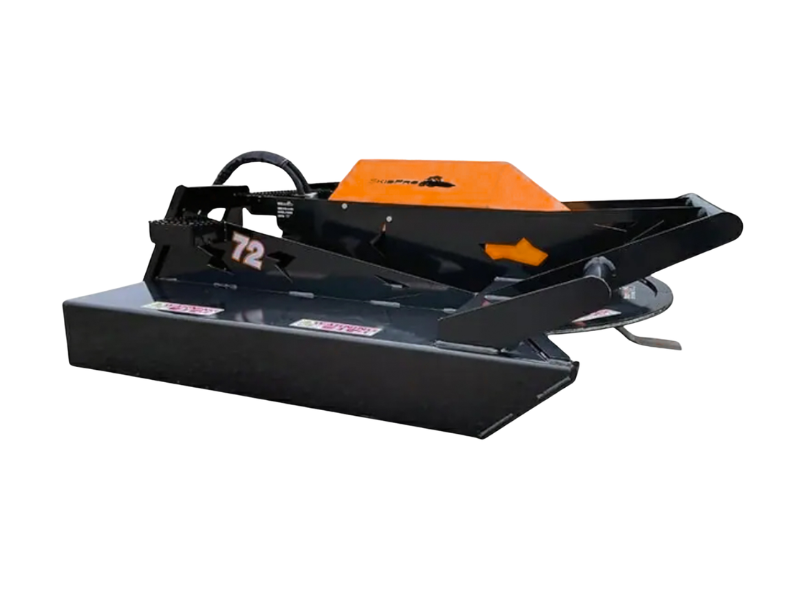
Skid steer brush cutter blades last until wear or damage reaches the cutter manufacturer’s replacement limits—not a universal number of operating hours. Vegetation, abrasive soil, hidden debris, and operating technique change how quickly that happens. Judge blade life by condition and the attachment’s manual; sharpening cannot restore a cracked, bent, or excessively worn blade.
Blade service life ends when the blade fails the manufacturer’s inspection criteria, even if it still cuts vegetation. For model-specific guidance, Skid Pro provides live Product Guru support 24 hours a day, 7 days a week. Have the attachment model and serial number ready rather than asking for a lifespan estimate based only on cutting width.
Use this inspection sequence to decide whether your blades can stay in service:
An hour-meter reading gives you maintenance history, not permission to keep cutting. In your 2026 maintenance log, record both operating time and the condition found at inspection. That combination helps you understand your own wear pattern without treating another operator’s experience as a guarantee.
A dull edge and a structurally damaged blade are different problems. Sharpening addresses the first only when the manufacturer allows it; the second requires replacement or another manufacturer-approved corrective action.
A brush cutter blade operates as part of a rotating assembly. Blade condition, mounting security, and the condition of the carrier all matter, so checking only whether the edge feels sharp misses part of the inspection.
Do not run a damaged blade until the job is finished. Stop and make the attachment safe when you notice new vibration, an abnormal sound, or a suspected impact. Inspect before restarting rather than trying to diagnose the problem while the cutter runs.
The right decision depends on what inspection reveals. These are maintenance choices, not interchangeable ways to extend every blade’s life.
| Action | Best for | Benefit | Limitation |
|---|---|---|---|
| Continue operating | Blades and mounting components that meet all inspection criteria | Avoids unnecessary blade removal | Requires continued inspection; an acceptable edge does not rule out other damage |
| Sharpen as permitted | Serviceable blades with edge wear the manual allows you to correct | Restores the specified edge geometry | Removes material and cannot fix cracks, bends, or excessive wear |
| Replace as specified | Blades outside replacement limits or with disqualifying damage | Removes an unserviceable component from the assembly | Requires the correct blade and inspection of related mounting parts |
Continuing to operate is appropriate when the blades, hardware, and carrier meet the cutter manufacturer’s requirements. Cutting performance alone is not the test. A blade can still cut while another part of the assembly needs attention.
Compare the blades with each other as well as with the manual. Uneven wear deserves investigation, particularly when it appears alongside vibration or a recent impact. Do not assume that the most visibly worn blade is the only component involved.
Sharpening is maintenance, not a reset of blade age. Every sharpening removes material, and the blade must remain within the specified dimensions and profile afterward.
Follow the required edge geometry rather than grinding the blade to a knife edge by habit. Check the manual’s instructions for removal, sharpening, balancing where applicable, and reinstallation. Do not borrow a procedure from a lawn mower or another brush cutter simply because its blade looks similar.
A crack, bend, damaged mounting area, or wear beyond the permitted limit is not an edge-maintenance problem. Replace an unserviceable blade instead of grinding around the damage. Do not straighten or weld a damaged blade unless the manufacturer explicitly provides an approved repair procedure.
Follow the cutter’s instructions on whether blades must be replaced together. Installing a new blade beside a substantially worn blade without checking those instructions leaves an important assembly requirement unresolved.
The same cutter can experience different wear on different properties. These factors explain why a single advertised hour estimate is a poor replacement rule:
Separate normal wear from a specific damage event in your 2026 service records. A blade replaced after striking an object tells you something different from a blade retired after gradual edge and body wear.
Start with the attachment manual’s access procedure. Shutdown alone is not a complete access plan: residual hydraulic pressure, unsupported equipment, and moving components require the precautions specified for the machine and cutter.
Once access is safe, work through the same checks each time:
This checklist keeps the cutting edge from becoming the only thing you examine. The mounting area and carrier belong in the same inspection because the blade depends on both during operation.
Photographs taken during a safe inspection help document changes. Include the blade body and mounting area, not just a close-up of the edge; an edge-only photograph leaves out parts that influence the service decision.
For your 2026 records, use consistent descriptions such as edge wear, mounting wear, impact damage, and permitted sharpening. These descriptions make repeat problems easier to distinguish from ordinary maintenance.
Sharpening can extend useful cutting service when the blade remains structurally sound and the manufacturer permits sharpening. It does not restore removed metal or erase damage, so inspection comes before the grinder.
Follow the approved profile and material-removal limits. If the manual does not provide a sharpening procedure, ask the manufacturer before improvising one. A sharper-looking edge is not proof that the blade remains suitable for service.
After reinstallation, follow the specified hardware, tightening, and operational-check procedures. Do not invent a torque value or reuse a damaged fastener because it fits. The blade and its mounting components must satisfy the attachment’s requirements together.
Replace blades together when the cutter manufacturer requires matched replacement. The answer depends on the assembly, so neither replacing only the damaged blade nor automatically replacing every blade is a universal rule.
Check the manual before ordering. Record which blades were removed, the reason for replacement, and any mounting parts changed at the same time. That record prevents a later inspection from treating blades with different service histories as equivalent.
Match the replacement to the exact cutter model and its parts information. Cutting width alone does not establish the correct blade, mounting arrangement, or hardware.
Provide the model, serial number, and existing part number where available. Ask whether the replacement procedure requires new mounting hardware, matched blades, or another component inspection. Keep those answers with the service record so the next replacement does not start from guesswork.
Skid Pro is best for skid steer attachment owners who want manufacturer-direct guidance on attachment selection and machine fit. The company manufactures attachments and offers live Product Guru support. That access does not remove the need to identify the cutter and verify its specifications; it is not a promise that any blade fits any attachment.
For a 2026 replacement inquiry, separate the blade question from the loader-fit question. Blade selection follows the cutter’s parts requirements; attachment compatibility also requires checking interface, hydraulic flow, pressure, weight, and intended use.
There is no universal operating-hour replacement limit for skid steer brush cutter blades. Use the cutter manufacturer’s wear and damage criteria, and record operating time alongside inspection findings.
Replace brush cutter blades when they fail the manufacturer’s inspection criteria. Check the blade body, edge, mounting area, and related components rather than judging only by cutting performance.
Sharpen a brush cutter blade only when it remains serviceable and the manufacturer permits sharpening. Grinding does not repair cracks, bends, damaged mounting holes, or wear beyond replacement limits.
Stop cutting and make the attachment safe when new or unexplained vibration develops. Inspect the rotating assembly and mounting components before restarting; do not assume a dull edge is the cause.
Replacement brush cutter blades are not universally interchangeable. Match the blade to the cutter model and parts requirements, including the specified mounting hardware.
Replace all blades together when the cutter manufacturer requires matched replacement. Follow the assembly-specific instructions rather than applying a rule from another attachment.
Record the cutter model, blade part number, operating time, replacement reason, and mounting components changed in your 2026 service log. Distinguish gradual wear from impact damage so later comparisons remain useful.
Record why a blade came out of service, not just when. An hour total without a replacement reason cannot distinguish abrasive wear, impact damage, mounting wear, and repeated sharpening.
Before your next job, confirm the correct blade information and inspection limits while the cutter is safely accessible. Finding that information before a failure gives you a clear maintenance decision instead of an improvised repair in the field.