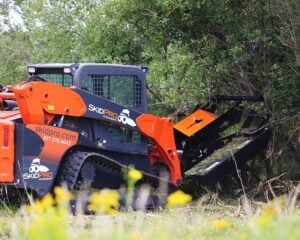

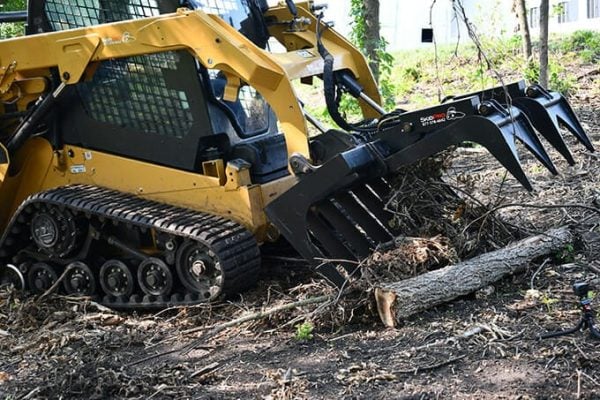
Land clearing involves more than cutting trees and vegetation. Brush, limbs, logs, roots, rocks, and other debris still need to be gathered and moved. Irregular or tangled loads can also be difficult to contain with a standard bucket.
Skid steer grapples give operators a practical way to clamp, retain, lift, and move these materials. The appropriate grapple depends on factors such as the skid steer’s capacity, the material being handled, and the requirements of the job.
This guide covers grapple configurations for land clearing and brush removal, factors to consider when selecting a skid steer grapple attachment.
A skid steer grapple is a hydraulic attachment that uses one or more movable upper jaws and lower tines to secure material. It typically mounts to the skid steer through a quick-attach system, while the machine’s auxiliary hydraulics power the grapple cylinders that open and close the jaws.
The lower tines support and help position the material as the upper jaw or jaws closes over it. Tine spacing and grapple opening vary by design, affecting the size, shape, and type of material the skid steer loader grapple can retain.
A skid steer loader grapple is used for land clearing and brush removal because it offers:
Skid steer grapple attachments are available in several configurations, with differences in frame design, tine arrangement, jaw configuration and digging profile.
| Configuration | Typical Applications | Defining Feature |
| Industrial Grapple Rake | Roots, brush, and land clearing debris | Open tine structure that can help separate soil and finer material from larger debris |
| Skeleton/Tine Grapple | Brush, logs, and general cleanup | Open frame with spaced lower tines for handling bulky debris |
| Rock Grapple | Rocks, roots, and mixed material | Tine spacing and frame design suited to retaining larger, dense material |
| Stump Bucket Grapple | Stumps, roots, and below-surface debris | Bucket-style digging profile combined with a grapple |
Start with machine capacity, then consider attachment size, hydraulic compatibility, grapple geometry, tine spacing, and construction.
The best grapple isn’t necessarily the biggest; it is the one that matches your machine, material, and workload.
Skid steer grapples and standard buckets serve different purposes. Buckets are generally used to scoop, carry, and dump loose materials, while grapples are suited to handling bulky, irregular, or tangled debris.
When comparing grapple manufacturers, look for clear product specifications, warranty information, parts availability, and support resources that apply to the attachment being considered. When evaluating a grapple manufacturer, consider:
Skid Pro offers a comprehensive collection of skid steer grapples for sale to meet different clearing requirements. The models below differ in their primary applications, so selection should be based on the work and the specifications of the skid steer being used, rather than treating one attachment as a universal option.
| Model | Primary application | Distinguishing feature |
| XHD Skeleton Grapple | General clearing | 35″ opening, ½” tines |
| Industrial Grapple Rake | Raking and grubbing | 41″ opening, 8 lower tines |
| XHD Rock Grapple | Rock and mixed-debris cleanup | 3″ tine spacing, 5/8″ tines |
| Stump Bucket Grapple | Stump and root work | 12″ digging width, 3 replaceable teeth |
Before and during operation, check the machine, attachment, and load. Operators should:
If the load cannot be controlled safely or visibility is inadequate, stop the operation and reassess reassess the load, attachment position, or operating method before continuing.
Regular maintenance can help identify problems before they affect the attachment’s operation. Follow the maintenance instructions provided for the specific grapple.
Maintenance requirements vary by grapple design and operating conditions, so the manufacturer’s service instructions should take precedence over a general maintenance routine.
The right grapple should fit the demands of the work and the skid steer being used. Skid Pro offers multiple grapple configurations for different clearing needs. Review Skid Pro’s grapple attachments based on the application, grapple configuration, and machine requirements.
There is no single best grapple for every job. Choose a configuration based on the material, application, and skid steer capacity, and hydraulic requirements.
Choose a width and operating weight that fit the skid steer and its rated operating capacity. Confirm the mounting system and hydraulic requirements before purchasing.
A grapple can gather and move small trees or saplings when the machine, attachment, and site conditions are appropriate. Whether it can pull or uproot vegetation depends on the attachment’s design and the job conditions. A grapple is primarily a handling attachment, not a cutting tool.
Yes, provided the grapple bucket’s mounting system, weight, capacity, and hydraulic requirements are compatible with the skid steer. Its bucket profile can also handle loose material alongside irregular debris.
Weight varies by configuration, width, and construction. Check the specific model’s operating weight and compare it with the skid steer’s rated capacity and the attachment manufacturer’s limits.

|
Product Image
|

|

|

|
|
Title
|
Brush Cutter - X4 Open Front Industrial | Brush Cutter - HD3 | Brush Mower - GB2 |
|
Weight
|
1,800 lbs. & 2,200 lbs. | Weight – 1,260 lbs | 1090 lbs |
|
Dimension
|
N/A | N/A | 90 × 80 × 36 in |
|
Description
|
Skid Pro’s High Flow Brush Cutter is a powerful skid steer attachment designed for heavy-duty vegetation clearing. Our skid steer high flow, open front industrial brush cutter is the premier brush cutter in the industry, bar none. This features a direct drive motor and a massive 467 lbs. flywheel that handles up to 10-inch trees with ease. It uses a robust Eaton 6000 series motor, capable of handling 60 GPM, providing exceptional cutting performance. The open front design allows for efficient cutting of large brush and trees, while the 10″ deck height and heavy-duty build ensure durability in the most challenging conditions. Available in 72″ and 84″ widths, it’s ideal for large-scale land clearing and maintenance tasks. To know more about the product, connect with our team now!
|
Skid Pro’s HD3 Heavy Duty Brush Cutter has an impressive 4-inch cutting capacity, making it ideal for tackling thick vegetation and heavy underbrush. Featuring rugged construction, our HD3 heavy duty brush cutter ensures high performance in challenging conditions. This heavy-duty brush cutter is perfect for land clearing, roadside maintenance, and heavy-duty landscaping projects. With advanced features, the heavy-duty brush cutter attachment delivers efficiency and durability you can count on. Browse our skid steer heavy duty brush cutter for sale to find the attachment for your vegetation removal needs.
|
Skid Pro’s skid steer brush mower, also known as the GB2, is designed for tackling tough vegetation. This entry-level mower is designed to tackle tall grass, dense brush, and overgrown areas. Compatible with major skid steer makes and models, the GB2 is versatile enough to take on almost any brush type, making it perfect for landscaping, land clearing, and maintenance. Our skid loader brush mower features robust construction that ensures durability and reliable performance across terrains. Elevate your outdoor projects with power and efficiency by choosing of the skid steer mowers for sale on this page.
|
|
Availability
|
In stock | In stock | In stock |
|
Flow
|
High/standard Flow | Standard Flow | High Flow |
|
Price
|
$5,190.00 – $5,645.00 | ||
|
Add to Cart
|
Read More | Read More | Select Options |