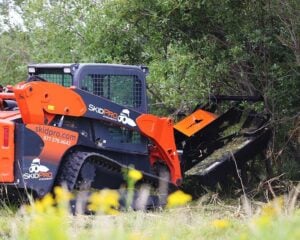

Choosing the right attachment for a skid steer starts with one specification that is easy to overlook: hydraulic flow.
Hydraulic flow is measured in gallons per minute (GPM), and it determines whether your skid steer can properly power an attachment such as a brush cutter, auger, trencher, snow blower, forestry mulcher, or disc mulcher.
The answer depends on the attachment. Some attachments work with standard-flow hydraulics around 10-25 GPM, while demanding high-flow attachments can require 25-45+ GPM.
Use the chart below as a starting point, then verify the exact GPM and PSI requirements for the attachment you’re considering.
| Skid Steer Attachment | Typical GPM Range | Hydraulic Flow | Common Applications |
| Grapple | 10-25 GPM | Standard Flow | Logs, brush, debris, material handling |
| Bucket | 10-25 GPM* | Standard Flow | Digging, loading, grading |
| Auger | 10-35 GPM | Standard to High Flow | Fence posts, landscaping, footings |
| Hydraulic Breaker | 10-25 GPM | Standard Flow | Concrete, rock, demolition |
| Trencher | 10-40 GPM | Standard to High Flow | Utility trenches, drainage |
| Brush Cutter | 15-60 GPM | Standard to High Flow | Grass, brush, vegetation |
| Brush Mulcher | 12-25 GPM | Low to Standard Flow | Brush, vines, saplings |
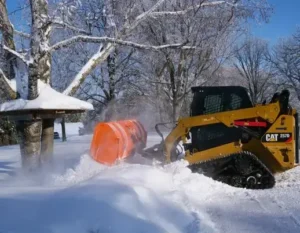
| Snow Blower | 15-40+ GPM | Standard to High Flow | Snow removal |
| Stump Grinder | 12-45 GPM | Standard to High Flow | Stump removal |
| Drum Forestry Mulcher | 17-45+ GPM | Standard to High Flow | Forestry, land clearing |
| Disc Mulcher | 27-45 GPM | High Flow | Heavy forestry, large trees |
| Cold Planer | 20-40+ GPM | Standard to High Flow | Asphalt and concrete milling |
| Concrete Saw | 20–40+ GPM | High Flow | Cutting pavement, concrete |
| Hydraulic Sweeper | 12–30 GPM | Standard to High Flow | Roads, lots, construction cleanup |
*Many buckets are non-hydraulic attachments, so GPM may not apply unless the bucket has hydraulic functions.
Important: GPM ranges vary by attachment manufacturer, model, hydraulic motor, and application. Treat this chart as a general guide, not a substitute for the attachment’s specifications.
GPM means gallons per minute.
It measures the amount of hydraulic fluid your skid steer can deliver to an attachment through its auxiliary hydraulic system.
The hydraulic motor inside an attachment uses that fluid to perform work.
For example:
The more demanding the hydraulic motor, the more important proper GPM matching becomes.
But GPM isn’t the only number you need to check.
When matching a skid steer to an attachment, you’ll usually see two hydraulic specifications:
They describe different aspects of hydraulic performance.
GPM = Hydraulic Flow
GPM tells you how much hydraulic fluid the skid steer can deliver.
PSI = Hydraulic Pressure
PSI tells you the pressure at which the hydraulic system operates.
That’s why you should always compare both GPM and PSI when selecting a hydraulic attachment.
Skid steers are commonly described as having either standard-flow or high-flow auxiliary hydraulics.
Although exact specifications vary by manufacturer, a useful general guideline is:
| Hydraulic System | Typical GPM Range | Common Attachment Types |
| Low Flow | 10–17 GPM | Light-duty hydraulic attachments |
| Standard Flow | 17–25 GPM | Augers, breakers, trenchers, grapples |
| High Flow | 26–45+ GPM | Forestry mulchers, disc mulchers, cold planers |
| Very High Flow | 40–45+ GPM | Heavy-duty specialty attachments |
These aren’t universal industry standards. Manufacturers use different definitions and offer different hydraulic packages.
The important thing is to compare your machine’s actual auxiliary flow rating with the attachment’s required operating range.
High-flow hydraulics are generally used for attachments with larger hydraulic motors or higher power requirements.
Common high-flow attachments include:
Many of the most common skid steer attachments don’t require high-flow hydraulics.
Examples include:
This is one reason standard-flow skid steers remain highly versatile.
You don’t need a high-flow machine simply because you want to use hydraulic attachments.
Instead, determine which attachments you’ll use most frequently and select the hydraulic configuration that supports them.
Using an attachment with the wrong hydraulic flow can create performance problems.
Too Little GPM
When the skid steer doesn’t provide enough flow, the attachment may:
Too Much GPM
If the attachment isn’t designed for the machine’s flow, excessive GPM can potentially:
The best combination is properly matched hydraulic flow and pressure.
Before buying an attachment, find your skid steer’s auxiliary hydraulic specifications.
Check:
If your skid steer has both standard-flow and high-flow auxiliary hydraulics, make sure you know which hydraulic circuit you’re using.
Suppose an attachment specification says:
Operating Flow: 25–35 GPM
This means the attachment is designed to operate within that hydraulic flow range.
If your skid steer provides only 15 GPM, it isn’t a proper match.
If your skid steer provides 30 GPM, you’re within the attachment’s operating range.
If your skid steer provides 45 GPM, you shouldn’t automatically connect it. Check whether the attachment can safely accept that flow.
The manufacturer’s specifications always take priority over a general hydraulic flow chart.
There isn’t one “best” GPM for every skid steer.
The right hydraulic flow depends on what you plan to do.
Choose lower flow if:
You mainly use:
Choose standard flow if:
You need a versatile machine for common construction and property-maintenance attachments.
Choose high flow if:
You regularly plan to operate:
Other high-demand hydraulic attachments
If your business depends on high-production forestry or land clearing, high-flow hydraulics can significantly expand your attachment options.
What GPM do most skid steer attachments require?
Many common skid steer attachments operate between approximately 10 and 25 GPM, while high-demand attachments can require 25-45+ GPM.
What is considered high-flow on a skid steer?
High-flow systems commonly fall in the 26-45+ GPM range, although manufacturers use different specifications and definitions.
Can I run a high-flow attachment on standard hydraulics?
A high-flow attachment shouldn’t be operated on a standard-flow machine simply because the hydraulic connections fit.
Can I run a standard-flow attachment on high flow?
Possibly, but you must verify the attachment’s maximum allowable flow. High-flow hydraulics can exceed the motor’s rated operating range.
Does GPM affect attachment speed?
Yes. Hydraulic flow can affect the operating speed of hydraulic motors. However, the relationship depends on the hydraulic motor’s displacement and the attachment’s design.
Does PSI or GPM matter more?
Both matter. GPM describes flow, PSI describes pressure, and together they determine the theoretical hydraulic power available to the attachment.
How do I know if my skid steer has high flow?
Check the machine’s specifications or operator’s manual for its auxiliary hydraulic flow rating. Don’t assume a machine has high flow based only on engine horsepower or model size.
Need Help Choosing a Skid Steer Attachment?
If you’re comparing attachments for forestry, land clearing, construction, or property maintenance, start by checking your skid steer’s GPM and PSI specifications.
Then compare those numbers against the attachment’s required hydraulic flow.
The right match isn’t necessarily the attachment with the highest GPM requirement. It’s the attachment that gives you the performance you need while staying within your skid steer’s hydraulic capabilities.
Not sure which attachment or hydraulic flow range is right for your skid steer? Contact the Skid Pro Guru for help choosing the right attachment for your machine and application.

Call one of our Product Gurus for more information & special promotions!

Click a category to see products
