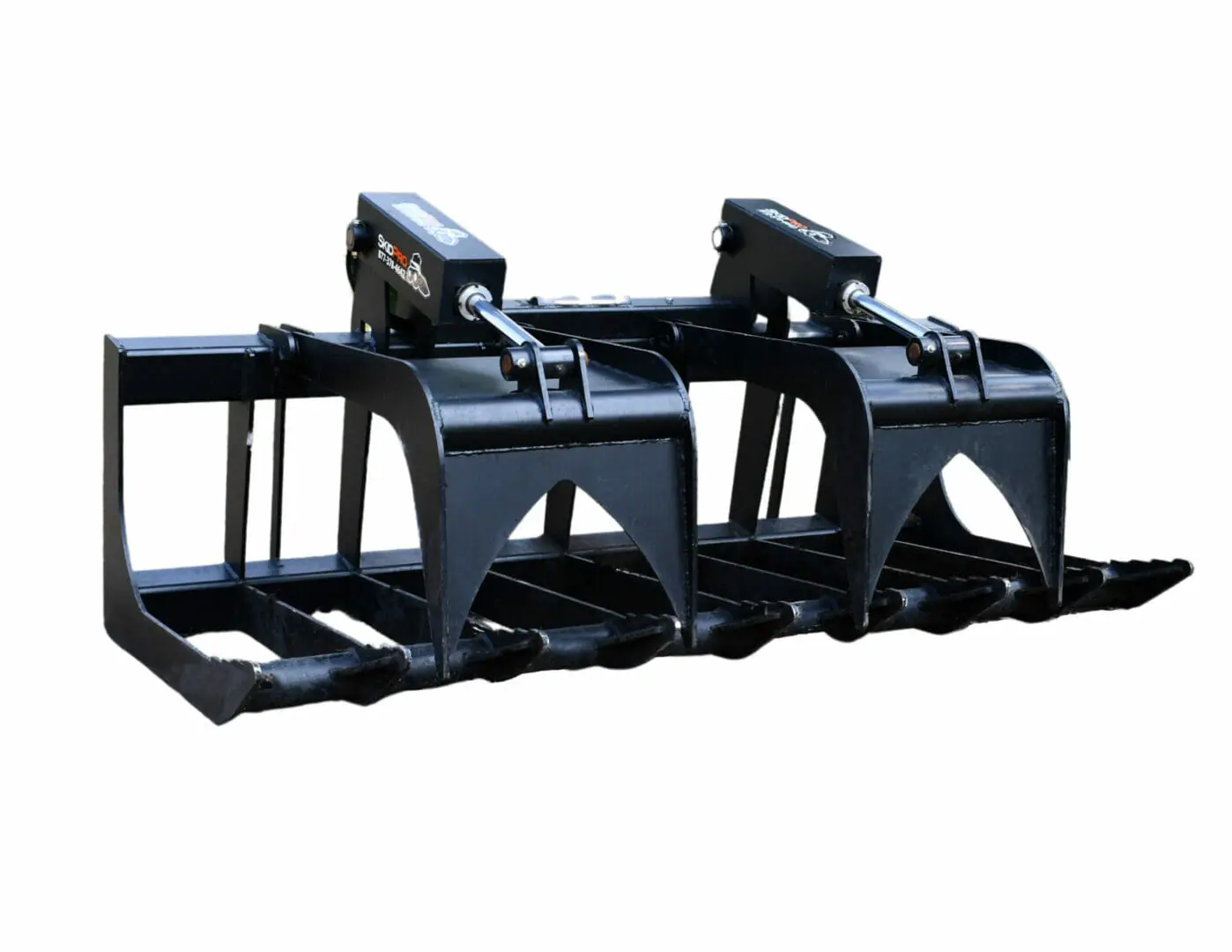
A conventional cylinder-operated skid steer grapple generally works with standard auxiliary hydraulic flow; the exact GPM requirement belongs to the attachment’s specifications, not a universal grapple rule. High flow is not automatically necessary or appropriate. For a 2026 purchase, check the grapple’s permitted flow and pressure, then confirm the mounting interface, hydraulic connections, attachment weight, and intended load before connecting it to your machine.
Use the flow specified for the exact grapple, rather than choosing the highest-flow circuit your loader offers. A conventional grapple uses hydraulic cylinders to open and close its jaws. That is a different hydraulic job from continuously driving an attachment motor.
Standard auxiliary hydraulics generally suit this cylinder-operated application. However, the words standard flow do not establish a particular GPM value or prove compatibility. You still need the loader’s auxiliary specifications and the grapple’s operating requirements.
| What you are checking | What it tells you | What it does not establish |
|---|---|---|
| Auxiliary flow, in GPM | Available oil delivery and its effect on cylinder speed | Permitted operating pressure or attachment fit |
| Hydraulic pressure, in PSI | Pressure available to act on the cylinder piston | Safe payload or sufficient flow |
| Grapple hydraulic specifications | The attachment’s permitted operating conditions | Whether your loader has matching settings |
| Mounting and connection requirements | Whether the attachment can connect as specified | Whether the loader can safely carry the load |
A loader’s maximum hydraulic output is not automatically the correct grapple setting. Match the attachment’s requirements first, then use the loader controls as its operator’s manual directs.
A grapple can mount on the loader and still be the wrong hydraulic or weight match. Slow jaw movement, abrupt operation, connection problems, and excessive attachment weight call for different checks; buying more hydraulic capacity does not answer all of them.
Skid Pro manufactures skid steer attachments directly for equipment owners. That manufacturer-direct relationship gives you a place to ask about the exact attachment configuration rather than relying on a category label or a loader brand name.
For a 2026 equipment purchase, treat hydraulic compatibility and load capacity as separate approval checks. Passing one does not excuse skipping the other.
Gallons per minute describes hydraulic flow: how much oil the circuit delivers over time. For a cylinder-operated grapple, oil must move into and out of the cylinders as the jaws travel.
With other conditions unchanged, more flow produces faster cylinder movement. Less flow produces slower movement. Cylinder dimensions, plumbing, valves, and restrictions also affect the response you get at the attachment.
Faster jaw movement is not the same as stronger gripping. If the grapple already opens and closes at a controllable speed, selecting a higher-flow setting is not a shortcut to better load retention.
Pounds per square inch describes hydraulic pressure. Pressure acting on the cylinder’s effective piston area produces cylinder force; the grapple’s linkage then translates that force into jaw movement and contact force.
That distinction matters when diagnosing a complaint. A jaw that moves slowly points you toward flow delivery and restrictions. A jaw that closes but cannot hold a suitable load calls for a broader check of pressure, load shape, contact, and mechanical condition.
Neither symptom proves a single cause. Verify the attachment’s permitted pressure before changing settings, and follow the manufacturer’s troubleshooting procedure instead of adjusting relief pressure by guesswork.
GPM and PSI do not establish safe lifting capacity. The attachment’s weight, the load’s weight, and the load’s position relative to the loader all matter.
A grapple holding material securely can still place the machine outside its permitted operating limits. Hydraulic grip and loader stability are separate questions.
For a conventional cylinder grapple, start with the attachment’s operating instructions, not the loader’s most powerful setting. If the loader offers selectable auxiliary modes, confirm which mode meets the grapple’s requirements.
| Auxiliary setting | Best for | Practical advantage | Limitation or check |
|---|---|---|---|
| Standard flow | Conventional cylinder grapples whose specifications permit it | Uses the ordinary auxiliary circuit for jaw operation | The label alone does not confirm GPM or pressure compatibility |
| Adjustable auxiliary flow | Matching jaw response to a permitted operating range | Lets you select a controlled response where the machine supports adjustment | Availability and adjustment procedure depend on the loader |
| High flow | Attachments that explicitly require or permit high flow | Supplies greater oil delivery when the application needs it | It is not automatically appropriate for a grapple or a way to increase grip |
Adjustable flow is useful only within the attachment’s allowed conditions. Do not confuse a convenient control setting with manufacturer approval.
If your grapple includes functions beyond opening and closing its jaws, identify those functions separately. A requirement for another hydraulic function does not establish the correct setting for every circuit on the attachment.
Collect the exact loader model and the exact grapple configuration before requesting compatibility confirmation. A brand name alone leaves too much unresolved.
Use these checks in order. Keep the relevant specifications together so you can compare the machine and attachment without switching between assumptions.
Machine interface. Confirm the mounting interface and the attachment’s required mounting arrangement. Check that the locking mechanism engages according to the machine and attachment instructions. Physical engagement does not establish hydraulic compatibility, and hydraulic compatibility does not establish a secure mount.
Auxiliary flow. Find the loader’s auxiliary output for the operating mode you intend to use, expressed in GPM. Compare it with the grapple’s published flow requirements or obtain confirmation from the attachment manufacturer. Do not substitute the loader’s total pump specification for its attachment-circuit specification.
Operating pressure. Compare the machine’s auxiliary pressure specifications with the grapple’s permitted operating pressure. Confirm any required setting or limit through the manuals or manufacturer. A connection that fits does not protect a component from operating outside its rating.
Hydraulic connections. Confirm the required couplers, hoses, circuit arrangement, and any additional connection requirements. Follow the specified pressure-release procedure before connecting or disconnecting. Check hose routing through the attachment’s permitted movement so the hoses are not pinched, stretched, or rubbed against moving parts.
Load capacity. Check attachment weight and the loader’s operating limits with the intended material and load position. Brush, logs, debris, and dense material do not impose identical loads. Select the attachment for the actual job, then operate within the machine and attachment instructions.
A complete match means all these checks agree. An unanswered item is a reason to obtain confirmation before use, not a reason to assume that a familiar loader brand makes the attachment compatible.
Compare the actual hydraulic design when evaluating grapples in 2026. Attachment width or the machine brand does not replace a hydraulic specification.
These factors explain why a single GPM recommendation cannot cover every grapple. The right answer is the attachment’s specified requirement paired with the loader’s verified output.
Check the circuit and operating setup before blaming insufficient GPM. Slow movement is a symptom, not a flow measurement.
Start with the loader’s operator’s manual and verify the selected auxiliary mode. Check any permitted flow adjustment, the required control input, and the operating conditions specified by the machine manufacturer.
Then inspect the connection and attachment as directed. A coupler that is not properly connected, a restricted hydraulic path, or a mechanical problem can affect operation. Do not force a connection or inspect a suspected pressurized leak with your hand; follow the hydraulic safety procedure and use qualified service support where required.
| Symptom | First check | Avoid this assumption |
|---|---|---|
| Both jaws move slowly | Auxiliary setting, connections, and manufacturer troubleshooting steps | The loader needs high flow |
| Movement is abrupt | Permitted flow setting and control operation | Faster movement means better performance |
| The jaw closes but material shifts | Load suitability, jaw contact, and attachment condition | More GPM will increase clamping force |
| A hose or fitting leaks | Safe shutdown and the specified inspection procedure | Continued operation will reveal the cause safely |
Do not hold the auxiliary control against a stopped cylinder unless the operating instructions call for it. Once cylinder travel stops, continued hydraulic operation does not create additional jaw travel and can generate heat through the circuit.
If the basic checks do not resolve the problem, stop and seek diagnosis. Provide the exact machine model, attachment identification, selected auxiliary mode, and a clear description of when the symptom occurs.
A conventional cylinder-operated grapple generally does not need high-flow hydraulics. Use high flow only when the exact attachment’s requirements permit or call for it.
The presence of a high-flow option on your loader does not make it the correct setting. Check the grapple’s specifications and the machine’s auxiliary controls together.
More hydraulic flow does not, by itself, increase a grapple’s clamping force. Flow affects cylinder speed; pressure, cylinder geometry, and linkage determine the available closing force.
If material slips, examine whether the load suits the grapple and whether the jaws contact it properly. Do not change hydraulic pressure or flow outside the specified limits to compensate for poor load placement.
Skid Pro skid steer attachments are best suited to operators who want to buy directly from the manufacturer and discuss machine fit before purchase. The company serves contractors, ranchers, landowners, and equipment operators and provides 24/7 Product Guru phone support.
That access does not remove the need to check specifications. For a 2026 fit discussion, provide the loader model, auxiliary GPM, operating pressure, mounting interface, and intended material; then request confirmation for the exact grapple configuration.
Ask what documentation establishes the match. A clear answer should address the hydraulic circuit and operating limits, not simply say that the attachment fits your loader brand.
A conventional cylinder-operated skid steer grapple generally uses standard auxiliary flow, but its exact GPM requirement comes from the attachment specifications. Compare those requirements with your loader’s auxiliary output and permitted settings.
You generally do not need high flow for a conventional cylinder-operated grapple. Confirm the exact attachment’s requirements before selecting standard or high-flow operation.
Higher GPM does not by itself give a grapple more clamping force. Flow affects cylinder speed, while pressure, cylinder geometry, and linkage determine available closing force.
Yes, a grapple can mount physically without matching the loader’s hydraulic operating conditions. Check flow, pressure, couplers, circuit requirements, attachment weight, and machine operating limits separately.
Slow opening requires checking the auxiliary setting, hydraulic connections, and the manufacturer’s troubleshooting instructions. The symptom alone does not prove that the loader lacks sufficient GPM.
Cross-brand use requires confirmation for each machine and attachment combination. Matching a brand name is not enough; the interface, hydraulics, connections, weight, and application must all be checked.
Send Skid Pro the exact loader model, auxiliary flow in GPM, operating pressure in PSI, mounting interface, and intended job. Ask for confirmation against the exact grapple configuration rather than a general category.
Before ordering a grapple in 2026, write down the loader’s selected auxiliary mode beside its flow specification. A maximum-output figure without the operating mode leaves the compatibility discussion incomplete.
Buy for the job and the verified circuit—not for the largest GPM number. A controllable grapple that matches the machine’s mounting, hydraulic, and load requirements is the goal. High-flow capability is useful only when the attachment actually calls for it.
Keep the confirmed specifications with the attachment instructions. That gives the next operator a documented setup instead of an assumption passed along with the machine.