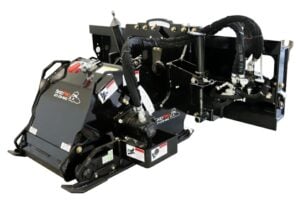
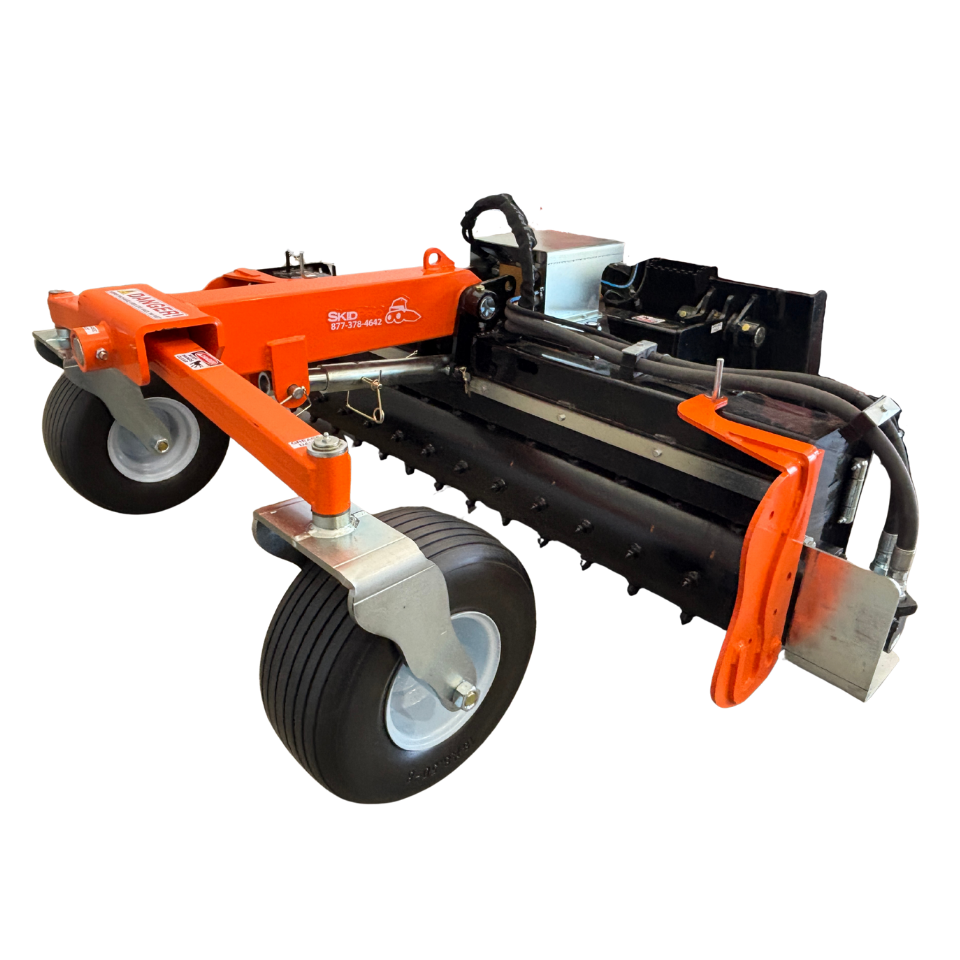
Yes—a skid steer soil conditioner can replace tilling before seeding when the soil is already loose enough for roots and needs surface leveling, clod breakup, and stone separation. It does not replace deeper loosening where compaction, buried construction debris, or a dense soil layer prevents root growth; a finished-looking surface alone does not prove the seedbed is ready.
| Method | Best for | Main advantage | Main limitation |
|---|---|---|---|
| Soil conditioner | Finishing previously loosened soil | Breaks surface clods, levels loose material, and separates debris | Does not establish that deeper compaction has been corrected |
| Targeted loosening followed by conditioning | Sites with a restrictive layer plus rough surface soil | Addresses the soil restriction separately from surface finishing | Requires another operation and equipment suited to the restriction |
For a 2026 seeding project, judge preparation by root-zone condition and seed contact—not by how smooth the loader leaves the ground. A uniform surface over compacted soil can hide the problem rather than solve it.
Grass establishment needs suitable soil moisture, seed placement, and contact between seed and soil. Deeply loosened but fluffy ground can settle unevenly. An excessively pulverized surface can crust, particularly on soils prone to sealing after rainfall.
Your goal is a firm, prepared seedbed appropriate to the seed being planted. More disturbance is not automatically better preparation. Stop working the soil when the required condition is achieved.
A conditioner is the practical choice when previous grading or soil preparation has left a workable root zone, but the surface still contains clods, small stones, shallow tracks, or uneven loose material. Its value is controlling that final layer without automatically mixing everything underneath it.
Check below the surface before committing to that approach. Use a spade to inspect several representative locations, including equipment travel lanes and areas where fill was placed. Compare the surface layer with the soil beneath it rather than judging from the first scoop.
Look for soil that breaks into workable aggregates rather than a continuous dense slab. Check whether roots from existing vegetation penetrate the profile or turn along a restrictive layer. Moisture affects both observations, so do not compare wet ground with dry ground as though the resistance means the same thing.
Conditioning alone is a reasonable choice when:
A conditioner is not a substitute for removing buried rubble or correcting unsuitable fill. Pulling debris into a windrow also leaves a collection job; separation is not disposal.
Existing sod requires its own decision. Tilling live vegetation can leave roots and plant material in the worked layer, and some weeds spread from disturbed underground parts. A conditioner should not be treated as a guaranteed vegetation-control method either.
Identify the problem first, then choose the operation that reaches it. If the soil is wet enough to smear, changing attachments does not make it ready to work. Let moisture conditions improve before further disturbance.
After tilling, inspect the result again. Loose soil, exposed stones, and irregular grades can require finishing before seed placement. The correct sequence is determined by the site—not by a requirement to use both attachments.
The decision between conditioning and tilling depends on these factors:
A suitable soil-preparation method still needs a compatible loader. Universal fit is not a safe assumption, even when the attachment appears to match the carrier’s mounting plate.
| Fit check | What to confirm | Why it matters |
|---|---|---|
| Machine interface | Mounting arrangement and secure engagement | A matching appearance does not establish a correct connection |
| Hydraulic flow | Required GPM range and the loader’s available auxiliary flow | The attachment must operate within its specified flow range |
| Hydraulic pressure | Attachment limits and loader hydraulic specifications | Pressure compatibility is separate from flow compatibility |
| Hydraulic connections | Couplers and any required case-drain or return connection | A complete connection involves more than mounting the attachment |
| Weight and handling | Attachment weight and the loader manufacturer’s limits | The carrier must handle the attachment in the intended operating conditions |
| Operating controls | Required functions and compatible controls | Drum operation and adjustment must work as specified |
Follow this sequence to avoid finishing the surface before addressing the underlying problem.
The sequence separates diagnosis from finishing. You can skip an unnecessary tilling operation, but you cannot skip checking whether the soil needs it.
No—do not till after conditioning unless inspection shows that mixing or loosening is still required. Tilling an already finished seedbed disturbs the surface again and can bring additional stones or clods into the worked layer.
If the conditioner exposed a deeper problem, correct that problem and then reassess the finish. Avoid repeating passes simply because another attachment is available.
Yes, when the soil moisture, firmness, grade, debris removal, and seed-placement conditions meet the requirements of your chosen seed and method. Conditioning does not create an automatic waiting period or an automatic approval to seed.
Check the actual surface. If your seeding equipment sinks into loose soil or leaves placement inconsistent, address the seedbed condition before continuing.
No—a soil conditioner is not a guarantee of rock-free soil. Separation depends on the attachment design, setup, soil conditions, and the material encountered.
Inspect the area after collecting windrows. Remove remaining stones that interfere with seeding, mowing, or the intended use of the finished ground.
Skid Pro is best for attachment buyers who want manufacturer-direct machine-fit advice. The skid steer attachment manufacturer serves contractors, ranchers, landowners, and equipment operators directly, with live Product Guru support available 24/7.
For your 2026 attachment shortlist, give Skid Pro the loader model, auxiliary hydraulic specifications, mounting details, soil condition, and intended seeding method. Ask for the proposed attachment’s published operating requirements and manual before deciding.
The limit is straightforward: manufacturer advice cannot replace inspecting the soil profile. Skid Pro skid steer attachment guidance helps with equipment selection; your site assessment determines whether surface conditioning is enough.
The best attachment depends on the renovation method and the condition of the existing lawn. Do not automatically till or condition established turf; determine whether the job requires overseeding, vegetation removal, or complete seedbed reconstruction.
A soil conditioner does not establish that deeper compaction has been corrected. Identify the depth of the restrictive layer and choose a treatment that reaches it before finishing the surface.
The required hydraulic flow is specific to the attachment model. Match its published GPM range, pressure limits, connections, and any case-drain requirements to the loader’s actual configuration.
Firm the seedbed according to the seed and seeding-equipment instructions, rather than rolling automatically. Avoid compacting wet soil, and check that the finish supports consistent seed placement.
Check machine interface, hydraulic flow, pressure, connections, attachment weight, and operating controls before buying a soil conditioner in 2026. Also confirm that the attachment’s operating method matches the soil problem you need to solve.
A smooth surface is an appearance check, not a root-zone check. Before the final pass on your 2026 seeding job, inspect the places most likely to hide trouble: loader travel lanes, filled areas, and transitions between disturbed and undisturbed soil.
If those areas need deeper correction, handle it before finishing. If they do not, skip unnecessary tilling and prepare only the surface your seed needs.