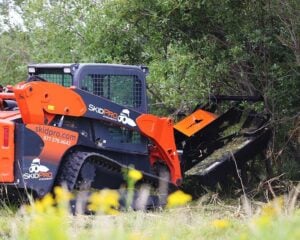

When it comes to land clearing, vegetation control, and property maintenance, one common question stands out: Brush cutter vs. mulcher – which is best?
The answer depends on your land type, project goals, budget, and desired finish quality. A brush cutter is best for cutting grass, weeds, and light brush (up to 4 inches) quickly and affordably. A mulcher is best for clearing thick brush, trees, and dense vegetation (3-12+ inches) because it grinds material into fine mulch and leaves a cleaner finish.
You may also hear a brush cutter referred to as a “brush hog” – it’s a common industry term (and originally a brand name) for the same type of heavy-duty rotary cutting attachment covered in this guide.
In this detailed comparison, we’ll break down how brush cutters and mulchers work, their pros and cons, cost considerations, and which one is right for your specific application.
A brush cutter is a heavy-duty attachment or machine designed to cut tall grass, weeds, light brush, and small saplings. It is commonly mounted on skid steers, tractors, or excavators.
How a Brush Cutter Works
Brush cutters use rotating steel blades to slice through vegetation at high speed. Instead of grinding material into fine mulch, they cut and drop it.
Best Uses for Brush Cutters
Pros of Brush Cutters
Cons of Brush Cutters
A mulcher (also called a forestry mulcher) is a powerful land-clearing attachment that cuts, grinds, and shreds vegetation into fine mulch.
There are two main types:
How a Mulcher Works
Mulchers use rotating drums or discs with carbide teeth to pulverize trees, brush, and vegetation into small chips. The result is an even layer of mulch left on the ground.
Best Uses for Mulchers
Pros of Mulchers
Cons of Mulchers
Feature | Brush Cutter | Mulcher |
Primary Function | Cuts vegetation | Cuts & grinds vegetation |
Best For | Grass & light brush | Dense brush & trees |
Debris | Left on surface | Processed into mulch |
Finish Quality | Rough | Clean & uniform |
Cost | Lower | Higher |
Power Requirement | Moderate | High |
Tree Capacity | Small saplings | Medium to large trees |
Replacement Parts | Lower-cost blades, simpler to replace | Carbide teeth cost more, replaced more frequently under heavy use |
Choose a brush cutter if:
You don’t need mulch processing
Choose a mulcher if:
If you need to clear a mix of light and heavy vegetation, such as grass, weeds, brush, and small trees, you might want to consider both attachments. You can use the skid steer brush cutter to mow the lighter vegetation first, then switch to the skid steer forestry mulcher to shred the heavier vegetation later. This way, you can optimize your efficiency and achieve the best results for your land.
For contractors:
In heavy land-clearing operations, mulchers typically generate higher long-term ROI.
How many acres can a forestry mulcher clear in a day?
Output varies significantly by machine size, horsepower, and vegetation density – smaller compact units cover less ground per day than high-horsepower, high-flow setups. For an accurate estimate of How many acres can a forestry mulcher clear in a day for your specific job, factor in your machine’s HP/GPM specs and the density of what you’re clearing.
Is a mulcher better than a brush cutter?
Not always. A mulcher is better for heavy brush and trees. A brush cutter is better for grass and light vegetation.
Can a brush cutter cut small trees?
Yes, brush cutters can cut small saplings, typically up to 2-4 inches in diameter. Larger trees require a mulcher.
Is a mulcher worth the investment?
A mulcher is worth the investment if you frequently clear thick vegetation or wooded areas, as it reduces cleanup time and increases job value.
Does a mulcher remove roots?
No. A mulcher shreds vegetation above ground. Root removal requires different equipment.
What is the difference between a brush hog and a mulcher?
A brush hog is another name for a brush cutter – a rotary cutting attachment built for grass, weeds, and light brush. A mulcher works differently: instead of cutting and dropping vegetation, it grinds trees, brush, and dense growth into fine mulch, making it the better choice for heavier, woodier material.
How big of a tree will a forestry mulcher cut?
It depends on the mulcher’s size, horsepower, and cutting head, but most forestry mulchers are built to handle vegetation and trees in the 3-12+ inch diameter range – heavier-duty, high-flow units on the higher end of that range. Check your specific mulcher’s spec sheet for its rated maximum.
What are the downsides of forestry mulching?
Mulching has a higher upfront investment than brush cutting, requires more horsepower to run effectively, and is generally slower than a brush cutter when working through light grass or open fields – it’s built for dense material, not speed on light vegetation.
There is no universal winner in the brush cutter vs. mulcher debate.
Your land type and workload determine the best equipment.
When comparing brush cutter vs. mulcher, the best choice depends on your project goals, land conditions, and budget. Carefully evaluate your needs before investing in equipment.
If you’re unsure which attachment fits your operation, consider consulting an equipment specialist such as the Skid Pro to ensure maximum productivity and ROI. Skid Pro also offers a full line of mulchers designed to meet a wide range of land-clearing needs, from light brush management to heavy-duty forestry applications.
Call one of our Product Gurus for more information & special promotions!

Click a category to see products
