
Efficient forestry management in 2026 requires more than simply removing trees. Modern land-clearing projects depend on advanced equipment, high-flow hydraulic systems, and sustainable vegetation management practices to improve productivity while minimizing environmental impact.
Whether you’re creating firebreaks, maintaining utility corridors, clearing overgrown properties, reclaiming land, or preparing sites for development, selecting the right forestry attachment can significantly affect project costs, productivity, and return on investment (ROI).
This guide explains how forestry mulchers, brush cutters, stump grinders, and log grapples work, how to match attachments to your machine’s hydraulic system, and the best practices professional operators use to maximize efficiency.
The Evolving Landscape of Forestry Management
Forestry management today encompasses a wide range of activities, including vegetation management, wildfire mitigation, right-of-way maintenance, land reclamation, site development, and habitat restoration.
Commercial operators face several significant challenges:
Labor Shortages
A shortage of experienced equipment operators has increased demand for machines and attachments that are easier to operate, safer, and more productive.
Environmental Accountability
Property owners, developers, and government agencies increasingly require responsible land-clearing practices that minimize soil disturbance, protect surrounding vegetation, and support environmental compliance goals.
Technology Integration
Modern forestry equipment often incorporates telematics systems, hydraulic monitoring, GPS tracking, and predictive maintenance tools that help operators monitor machine performance, reduce downtime, and improve fleet management.
Wildfire Prevention and Vegetation Management
Across many regions, proactive vegetation management has become a critical strategy for reducing wildfire risk. Forestry mulching and brush-clearing operations help create defensible space, firebreaks, and access routes for emergency response.
Essential Forestry Attachments for Modern Land Management
Choosing the right attachment is one of the most important decisions in any forestry or land-clearing project. Different attachments are designed for specific stages of the clearing process, from removing standing trees to handling debris and preparing the site for development.
Forestry Mulcher
A forestry mulcher uses a rotating drum or disc equipped with cutting teeth to process trees, brush, and woody vegetation into mulch.
Commercial forestry mulchers can often clear between 1 and 4 acres per day depending on vegetation density, terrain, machine horsepower, and operator experience.
See It in Action: https://www.youtube.com/watch?v=yEDF-3T14Rg
Open Front Brush Cutter
Brush cutters are designed for rapid vegetation removal. When speed and coverage are priorities, brush cutters are often the most efficient first-pass attachment.
See It in Action: https://www.youtube.com/watch?v=_9Y7S6c4nHw
Tree Puller
Tree pullers are designed to grip and remove small trees, saplings, shrubs, and invasive vegetation directly from the ground, including much of the root system.
Because they remove roots along with vegetation, tree pullers can help reduce regrowth.
See It in Action: https://www.youtube.com/watch?v=AuSSYitlBQ4
Tree Shear
Tree shears cut standing trees cleanly at the base while allowing operators to maintain control of the tree during removal.
See It in Action: https://www.youtube.com/watch?v=9OMWJpj-qjk
Tree Saw
Tree saw attachments use a high-speed circular blade to cut standing timber quickly and efficiently.
See It in Action: https://www.youtube.com/watch?v=qzq6lr56Gy0
Grapples
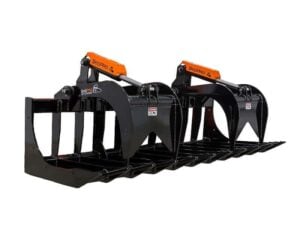
Grapples are among the most versatile attachments used in forestry and land management. After vegetation has been cut, mulched, or removed, grapples play a critical role in improving cleanup efficiency and reducing manual labor.
See It in Action: https://www.youtube.com/watch?v=2pmHZll1exg&list=PLXHOcSIWV1JWl28H0xI0EhoIr-eeCNsiu
Log Splitter
Log splitters use hydraulic force to split large logs into manageable firewood or processing material. Hydraulic log splitters improve productivity while reducing physical labor.
See It in Action: https://www.youtube.com/watch?v=nh-uVWaPi0A
Stump Grinder
A stump grinder removes remaining tree stumps after clearing operations.
See It in Action: https://www.youtube.com/watch?v=rTvXkR49YfM
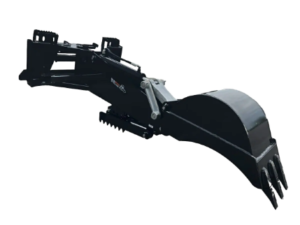
Stump Bucket
A stump bucket is designed to dig around roots, remove stumps, extract rocks, and perform targeted excavation work.
See It in Action: https://www.youtube.com/watch?v=9i70ZwowgX4
Choosing the right attachment is one of the most important decisions in any land-clearing project.
Forestry Attachment Comparison Guide
| Attachment | Primary Purpose | Best Application | Flow Requirement |
| Forestry Mulcher | Vegetation processing | Dense brush and trees | High Flow Preferred |
| Brush Cutter | Rapid vegetation removal | Grass, weeds, light brush | Standard or High Flow |
| Tree Puller | Root-level removal | Saplings and invasive species | Standard Flow |
| Tree Shear | Precision tree cutting | Standing tree removal | Standard or High Flow |
| Tree Saw | High-volume tree cutting | Utility corridors and timber removal | Standard or High Flow |
| Grapple | Material handling | Logs, brush, and debris cleanup | Standard or High Flow |
| Log Splitter | Wood processing | Firewood and log preparation | Standard or High Flow |
| Stump Grinder | Stump removal | Final site preparation | Standard or High Flow |
| Stump Bucket | Digging and extraction | Stumps, roots, and rocks | Standard Flow |
High-Flow vs. Standard-Flow Hydraulics
One of the most common causes of poor performance in forestry operations is using an attachment that does not match the machine’s hydraulic capabilities.
Pro Tip: Always match your attachment’s hydraulic motor requirements to your skid steer’s available GPM and hydraulic horsepower specifications.
Best Practices for Professional Site Preparation
Successful forestry projects rely on efficient workflows as much as equipment selection.
The Three-Pass Clearing Method
Many professional operators use a structured three-pass approach:
Pass 1: Initial Vegetation Removal
Use a brush cutter to remove grass, weeds, and light vegetation quickly.
Pass 2: Woody Material Processing
Deploy a forestry mulcher to process trees, brush, and woody debris into mulch.
Pass 3: Final Site Preparation
Use a stump grinder to remove remaining stumps and prepare the site for grading, construction, landscaping, or agricultural use.
This workflow often improves productivity while producing a cleaner finished site.
Prioritize Operator Safety
Follow established safety procedures at all times:
Hydraulic system failures can create costly downtime.
Best practices include:
Preventive maintenance often costs significantly less than emergency repairs.
Common Forestry Equipment Mistakes
Avoid these frequent operator errors:
Choosing Attachments Based on Price Alone
Lower-cost attachments may not provide sufficient durability for commercial workloads.
Ignoring Hydraulic Requirements
An improperly matched attachment can reduce productivity and increase maintenance costs.
Skipping Preventive Maintenance
Neglected hydraulic systems frequently experience overheating and component failure.
Using the Wrong Tool for the Job
Brush cutters, mulchers, stump grinders, and grapples each serve different purposes. Selecting the correct attachment improves efficiency and equipment longevity.
Frequently Asked Questions
Can a skid steer mulcher be used for commercial forestry?
Yes. Modern heavy-duty forestry mulchers are specifically designed for commercial land-clearing applications and can often clear between 1 and 4 acres per day depending on vegetation density and site conditions.
How many GPM does a forestry mulcher require?
Requirements vary by model, but most commercial forestry mulchers perform best on high-flow hydraulic systems ranging from 26 to 45+ GPM.
Can a standard-flow skid steer run a forestry mulcher?
Some light-duty mulchers are compatible with standard-flow machines, but commercial forestry applications generally benefit from high-flow systems for optimal productivity.
How do I prevent hydraulic overheating?
Match attachment requirements to machine specifications, maintain clean cooling systems, monitor hydraulic pressure, and follow recommended maintenance schedules.
What attachment is best for creating firebreaks?
Forestry mulchers and brush cutters are commonly used to create firebreaks by reducing vegetation and combustible fuel loads.
Choosing the Right Forestry Attachment for Your Operation
Before purchasing or renting equipment, evaluate:
Selecting the right attachment for your machine and application can significantly improve productivity, reduce downtime, and increase profitability.
Ready to Optimize Your Forestry Operation?
At Skid Pro, our attachments are built by operators for operators. Whether you’re looking for a high-performance forestry mulcher, heavy-duty brush cutter, stump grinder, or grapple, our team can help you find a solution that matches your machine, workload, and productivity goals.

Call one of our Product Gurus for more information & special promotions!

Click a category to see products
